 Senior Health Wellness
What Is the VA Homemaker and Home Health Aide Program?
The VA Homemaker and Home Health Aide program sends a trained, VA-contracted aide into a veteran’s home on a regular schedule. This aide helps with bathing, dressing, meals, and light housekeeping. A registered nurse supervises the care and checks in regularly. The program also covers respite care for family caregivers, giving them a scheduled break from daily duties.
Under this program, the aide works for an agency under contract with the VA. The veteran doesn’t hire or manage the aide directly. Families don’t manage staffing or payroll. The contracted agency handles hiring, training, and background checks instead.
If an assigned caregiver gets sick or becomes unavailable, the agency arranges a replacement. That built-in backup is one reason many families prefer this option. There’s less to coordinate personally. And there’s less risk of a gap in care when someone can’t make a scheduled visit.
What Is Veteran-Directed Care?
Veteran-Directed Care works differently. The VA gives the veteran, or their representative, a flexible budget instead of an assigned agency. That budget pays for home and community-based services chosen by the veteran. A counselor helps set up a spending plan at the start, based on assessed care needs.
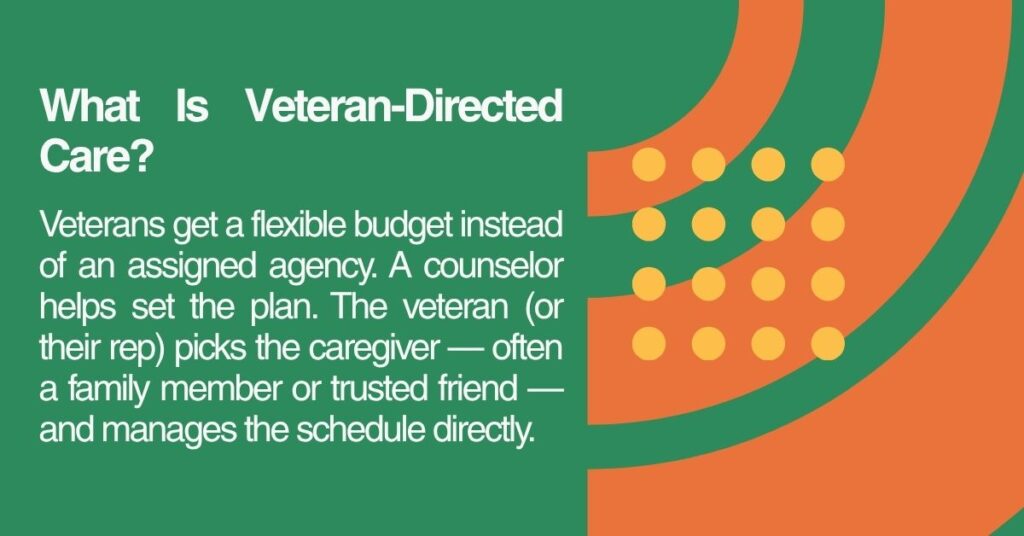
The biggest difference is control. Veterans can hire their own caregivers under this program. In many areas, that includes family members or trusted friends, as long as local rules allow it. The veteran or their representative manages the schedule. They also supervise the work directly, rather than relying on an outside agency’s staffing.
This approach suits families who want more say in who provides care and when. It takes more hands-on management than the alternative. But it offers a kind of flexibility some families value highly. That’s especially true when a trusted family member is willing and able to provide hands-on support.
A Quick Side-by-Side Look
Before the details above, here’s how the two programs compare in plain terms.
- Who assigns the caregiver: agency-based program assigns one; self-directed budget lets the veteran choose
- Can a family member be paid to provide care: generally no under the agency model; often yes under the self-directed option
- Who manages the schedule: the contracted agency handles this; the veteran or representative handles this
- Level of day-to-day involvement needed from the family: lower; higher
- Backup coverage if a caregiver is unavailable: built in through the agency; arranged by the veteran or representative
This snapshot isn’t exhaustive, and exact details can vary by VA medical center and by individual care plan. But it’s a useful starting point. Bring it to a conversation with a VA social worker about which structure fits your household.
Key Differences Between the Two Programs
Both options help veterans stay in their own homes. Each one can include respite care for family caregivers. Still, they differ in a few important ways worth understanding before choosing.
Who Provides the Care
Under the agency-based model, a VA-contracted agency assigns a trained aide. The veteran doesn’t choose the specific person, though most agencies try to accommodate preferences and requests over time. Under Veteran-Directed Care, the veteran picks the caregiver directly. That can include a family member in many locations, something the agency-based program generally doesn’t allow.
How Much Control the Veteran Has
The agency-run program follows a set schedule managed by the contracted provider. Veteran-Directed Care puts the budget and schedule in the veteran’s own hands instead. Some families want less to manage day to day. Others want maximum flexibility, and they’re comfortable handling the coordination themselves.
Respite Care Options
Both programs include respite care as a built-in option. The specifics vary by location and by the veteran’s individual care plan. It’s worth asking directly what respite looks like under each program locally. Availability isn’t identical everywhere, and some regions offer more robust respite scheduling than others.
Related Source: According to the VA’s Office of Geriatrics and Extended Care, both programs sit inside the VHA Standard Medical Benefits Package. Enrolled veterans qualify once they meet the clinical need for the service.¹ ²
Eligibility for Each Program
The Homemaker and Home Health Aide program is part of the VA’s standard medical benefits package. Any enrolled veteran who meets the clinical need qualifies, regardless of age. A copay may apply, depending on service-connected disability status.
Veteran-Directed Care is also open to veterans of any age. Eligibility depends on health status and documented care needs, similar to its agency-based counterpart. Availability can vary more by region here. Local Area Agencies on Aging help administer the program in partnership with the VA.
Neither program requires a specific disability rating. Both are based primarily on functional need. That means whether the veteran genuinely requires help with daily activities and personal care, as documented by a physician or VA care team.
Can They Be Combined With Other VA Benefits?
Home care benefits like these are often used alongside Aid and Attendance pension payments. The two serve different purposes, though. Aid and Attendance provides monthly financial support directly to the veteran or surviving spouse. The programs covered here provide the actual in-home service or caregiving budget itself.
A veteran can potentially use Aid and Attendance funds for additional support. At the same time, they can separately manage a Veteran-Directed Care budget for hands-on caregiving. Every situation looks a little different. A VA social worker or accredited claims agent can help map out how these pieces fit together for your family.
Families still working through the Aid and Attendance application itself can also get help from our partner, the VetAssist Program at Veterans Home Care. They specialize in that application specifically. And they can advance care costs through a 0% interest loan while a claim is pending.
Which Program Might Fit Your Family?
There’s no universal right answer here. Consider two common scenarios families face.
A veteran who wants consistent, professionally managed care, with minimal day-to-day involvement, often does well with the agency-based option. There’s a team behind the scenes handling scheduling, backup coverage, and supervision. That structure appeals to families juggling work and other responsibilities.
A veteran who wants a family member providing care often leans toward the self-directed budget instead. So does a veteran who wants more control over scheduling and provider choice. This works especially well when an adult child or spouse is already involved in caregiving. It lets that person be compensated and supported for what they’re already doing.
Some families start with one program and later switch. That happens once they understand what daily life with each option actually looks like in practice. That’s normal, and it doesn’t mean the first choice was wrong. A conversation with a VA social worker is the best starting point either way. They know what’s realistically available in your specific area.
How to Get Started With Either Program
Both paths start in the same place: a conversation with the VA. Enrolled veterans can talk with a VA social worker or case manager. That conversation can happen at a VA medical center or through the VA’s caregiver support line. It typically covers current health status, daily care needs, and what’s available in your specific region.
For the Homemaker and Home Health Aide program, the VA connects the veteran with a contracted agency once eligibility is confirmed. Care typically begins with an in-home assessment to build the initial care plan.
For Veteran-Directed Care, the process usually involves an assessment through a local Aging and Disability Resource Center. From there, a veteran works with an assigned counselor to build a spending plan. This step takes a bit more coordination up front. But it sets the foundation for how the flexible budget gets used.
Either way, patience helps. These programs involve real people making individualized decisions, not automatic approvals. Following up periodically, and keeping documentation organized, tends to move things along faster.
A Common Scenario
Consider a veteran managing early-stage mobility limitations, still largely independent but needing help a few times a week. Their daughter lives nearby and already stops by often to help with errands and meals.
For this family, Veteran-Directed Care might make sense. The daughter could become a paid, trained caregiver through the program, formalizing support she’s already providing informally. That can ease financial strain on the family while keeping care in trusted hands.
Now consider a different veteran, living alone with more significant daily care needs. Their family lives out of state and can’t be hands-on day to day. For this family, the agency-based Homemaker and Home Health Aide program often makes more sense. A professional team handles scheduling and backup coverage without requiring a family member to manage it remotely.
Neither scenario is more “correct” than the other. The right fit depends entirely on the veteran’s needs and the family’s situation.
Common Questions From Families
Can I switch between programs later?
Yes, in most cases. Care needs change over time. The VA generally allows veterans to reassess and switch programs if circumstances shift significantly. It’s worth checking with your VA social worker before assuming either choice is permanent.
Do I need Aid and Attendance to qualify?
No. Both home care programs discussed here are separate from the Aid and Attendance pension. A veteran can qualify for either one without receiving Aid and Attendance at all. Many families end up using both benefits together over time, though.
What if my area doesn’t have Veteran-Directed Care?
Availability varies by region. Not every VA medical center area has this program fully rolled out yet. If it isn’t available locally, the agency-based Homemaker and Home Health Aide option is usually still on the table. Other home and community-based VA services may be worth asking about too.
Can a spouse be the paid caregiver under Veteran-Directed Care?
In many locations, yes, though rules vary by state and by VA medical center. Some areas restrict payment to certain family relationships, or set specific training requirements first. A counselor assigned to the program can confirm what’s allowed locally. Check before you commit to a caregiving arrangement.
In-Home Care Support in Boca Raton, Delray Beach, and Boynton Beach
City Choice Home Health Care has supported families across Palm Beach County for more than two decades. That includes over 1,000 families in Boca Raton, Delray Beach, and Boynton Beach who’ve leaned on us during difficult transitions.
We work with veterans navigating both VA program paths. Sometimes that means coordinating alongside a VA-contracted care plan. Other times, it means supporting a family managing their own self-directed caregiving budget. Either way, our role stays the same: making sure the veteran gets consistent, quality care at home.
Every family’s situation looks different. Some veterans need a few hours of help each week. Others need more consistent daily support with personal care and mobility. Our team can talk through what either path might look like day to day. We can also explain how our services could work alongside whichever program you choose.
If you’re weighing these two options for a veteran in your family, reach out. We’re happy to talk through what each involves, without pressure or a sales pitch attached.
Related Articles
- VA Aid and Attendance: How Veterans in Palm Beach County Can Pay for In-Home Care
- Benefits of Home Care in Palm Beach
- What Home Health Aides Can (and Can’t) Do at Home