 Senior Health Wellness
Your father used to love Sunday dinners. Lately, he sits quietly while everyone talks around him. He nods along, but his answers do not quite match the questions. Some in the family worry it is memory loss. Others think he just cannot hear.
It could be both. Research now shows a strong link between hearing loss and dementia, one that researchers have studied for more than a decade. And unlike many risk factors, hearing loss is one families can actually do something about. This guide explains what the science says, what signs to watch for, and how to help a loved one in Delray Beach stay connected.
Can Hearing Loss Cause Dementia?
Hearing loss does not directly cause dementia, but it is one of the strongest known risk factors for it. Studies show that older adults with untreated hearing loss face a higher risk of developing dementia, and the risk rises as hearing gets worse. Researchers believe strain on the brain, social isolation, and brain changes may explain the connection.
In other words, the two are linked, but hearing loss is not a guarantee. Many people with poor hearing never develop dementia. Still, the pattern is consistent enough that dementia experts now treat hearing as a key part of brain health.
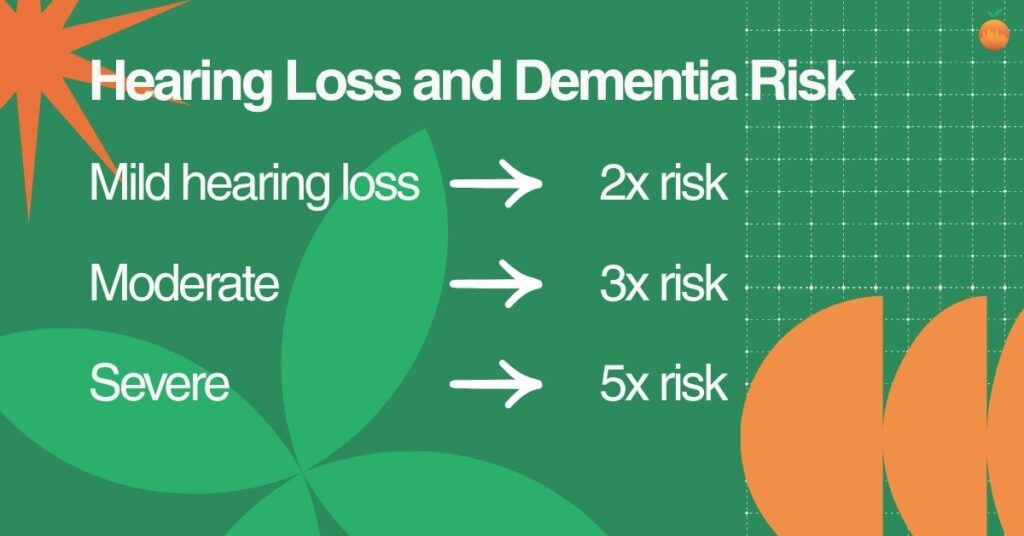
Related Study/Source: A 2011 study in Archives of Neurology followed 639 adults for nearly 12 years. Compared with people who had normal hearing, those with mild hearing loss were about twice as likely to develop dementia. The risk was about three times higher with moderate loss and about five times higher with severe loss.¹
How Big Is the Risk?
In 2024, the Lancet Commission on dementia prevention reviewed the global evidence. It identified 14 risk factors that people can change over their lifetime. Hearing loss in midlife was among the largest on the list.
The commission estimated that nearly half of dementia cases worldwide might be delayed or prevented by addressing these 14 factors. Treating hearing loss was one of the most practical steps it named.² That matters, because hearing loss is extremely common. About one in three adults between ages 65 and 74 has some hearing loss. After age 75, the number climbs to nearly half.
Why Are Hearing Loss and Dementia Connected?
Scientists are still working out the exact reasons. Right now, three explanations have the most support.
Cognitive load. When hearing fades, the brain works harder to decode sound. That extra effort may pull resources away from memory and thinking. Over years, the strain may take a toll.
Social isolation. Straining to follow conversations is exhausting. So many people with hearing loss slowly pull back from friends, clubs, and family gatherings. Loneliness and low mental stimulation are both linked to faster cognitive decline.
Brain changes. Imaging studies suggest the parts of the brain that process sound may shrink faster when they receive less input. Those regions also play roles in memory and language.
These factors likely work together. And they reinforce each other, which is why early action matters.
There is a hopeful side to this research. If hearing loss and dementia share a pathway, then protecting hearing may protect thinking too. Few dementia risk factors are as easy to test for or as practical to treat. A simple hearing screening takes less time than a routine dental cleaning.
Signs of Hearing Loss in Older Adults
Hearing loss usually creeps in so slowly that the person affected may not notice. Family members often spot it first. Watch for these common signs:
- Turning the TV or radio up louder than others prefer
- Asking people to repeat themselves often
- Trouble following conversations in restaurants or groups
- Answering questions with responses that do not quite fit
- Missing the doorbell, phone, or kitchen timer
- Saying other people “mumble”
- Avoiding social events they once enjoyed
- Seeming tired or irritable after conversations
Is It Hearing Loss, Dementia, or Both?
This is where things get tricky. The two can look remarkably alike. A person who cannot hear well may seem confused, forgetful, or withdrawn. They may repeat questions because they missed the answer. Or they may give off-topic replies because they misheard.
Sometimes families assume dementia when the real problem is hearing. Other times, hearing loss hides early memory changes. And in many older adults, both are present at once.
That is why a hearing test should come early in any memory evaluation. Ask your loved one’s doctor for a referral to an audiologist. It is a simple, painless test. And it can change how every other result is read.
If your loved one resists the idea of a memory check, our article on when a mother is in denial about dementia offers practical ways to approach the conversation.
What to Expect at a Hearing Test
Many seniors put off a hearing test because they are not sure what it involves. The good news is that it is quick, comfortable, and completely painless.
An audiologist usually starts with questions about daily life. Which situations are hardest? Does one ear seem worse? Then they look inside the ears to check for wax buildup, which is a surprisingly common and easily fixed cause of muffled hearing.
Next comes the listening part. Your loved one sits in a quiet booth wearing headphones and signals when they hear a tone. They may also repeat words spoken at different volumes. The whole visit often takes under an hour.
Afterward, the audiologist explains the results in plain language. If hearing aids make sense, they will talk through options and costs. Bringing a family member along helps, since two sets of ears catch more of the details.
Do Hearing Aids Lower Dementia Risk?
Hearing aids may help slow cognitive decline in some older adults, especially those already at higher risk. A 2023 clinical trial found that people at higher risk who received hearing care saw about 48% slower decline over three years. The benefit was not seen in the healthier group, so hearing aids help but are not a guaranteed shield.
That trial, called ACHIEVE, was the first major randomized study to test this question directly.³ Its findings were mixed, but encouraging. Other large observational studies have also found lower dementia rates among people who use hearing aids compared with those who do not.
Beyond brain health, hearing aids bring clear everyday benefits. People who hear better tend to stay more social, feel less isolated, and enjoy conversations again. That alone makes them worth considering.
Why Many Seniors Resist Hearing Aids
Many older adults who need hearing aids never get them. Or they get them and leave them in a drawer. The reasons are understandable.
Some feel hearing aids make them look old. Others had a bad experience with older, bulky models. Cost is a real barrier for many families. And adjusting to new sounds can feel overwhelming at first.
Modern hearing aids are much smaller and more comfortable than older styles. Since 2022, over-the-counter hearing aids have also been available in the U.S. for adults with mild to moderate hearing loss. That has lowered costs for many people. For more significant loss, an audiologist fitting is still the best route.
Patience helps. It can take several weeks for the brain to adjust to amplified sound. Encourage your loved one to wear the devices a little longer each day.
Tips for Better Conversations at Home
Whether or not your loved one uses hearing aids, small changes in how you talk can make a big difference.
- Face them directly so they can see your lips and expressions
- Get their attention before you start speaking
- Speak clearly and at a normal pace, without shouting
- Turn off the TV or move away from background noise
- Rephrase instead of repeating the same words louder
- Keep good lighting on your face
- Check in to make sure they followed what you said
Also avoid talking down to your loved one. Slow, sing-song speech can feel belittling, even when it is well meant. Our guide on elderspeak explains why tone matters as much as volume.
When Both Conditions Show Up Together
When hearing loss and dementia appear together, daily life needs a few extra adjustments. Each condition makes the other harder to manage. Poor hearing adds to confusion. Memory loss makes it harder to remember hearing aids, instructions, or new routines.
Safety deserves special attention. A person who cannot hear well may miss a smoke alarm, a knock at the door, or a car backing out of a driveway. Consider alarms with flashing lights or bed-shaker alerts. Keep a written list of daily tasks and medications where your loved one can see it.
Doctor visits also call for planning. Important instructions are easy to mishear or forget. So go along when you can, take notes, and ask the doctor to write down key points.
Finally, keep expectations kind. Your loved one may not follow every conversation, and that is okay. Simple, face-to-face moments still matter. A shared meal, a favorite song, or a quiet walk can connect you when words fall short.
Supporting a Loved One in Delray Beach
Delray Beach offers plenty of ways for seniors to stay socially active. Community centers, faith groups, clubs, and family gatherings all help keep the mind engaged. But those activities only help if your loved one can hear well enough to take part.
Start with a hearing test. Then look at the daily routine. Is your loved one spending most days alone? Are they skipping outings because conversations are too hard? These are signs they may need more support at home.
How City Choice Can Help
Families often tell us the hardest part is not knowing what is going on. Is it hearing? Memory? Both? A caregiver who sees your loved one regularly can notice small shifts that busy relatives might miss. Those observations help doctors understand the full picture of hearing loss and dementia risk.
City Choice Home Health Care has served families across Delray Beach, Boca Raton, and Boynton Beach for more than two decades. Our Medicare-certified team has cared for more than 1,000 families. We understand how hearing, memory, and daily life connect.
Our caregivers can support your loved one in practical ways:
- Offer daily companionship and meaningful conversation
- Help your loved one keep up with hearing aid care, cleaning, and battery changes
- Provide transportation to audiology and doctor appointments
- Notice changes in hearing, memory, or mood and share them with the family
- Encourage social outings and activities that keep the mind active
For families already facing memory changes, our guide on dementia care offers more next steps. When you are ready, call us to talk about what your loved one needs.
Frequently Asked Questions
Does Hearing Loss Lead to Dementia in Everyone?
No. Many people with hearing loss never develop dementia. Hearing loss raises risk, but it is one factor among many. Age, genetics, heart health, and lifestyle also play roles.
Can Treatment Reverse the Decline?
There is no evidence that hearing aids reverse dementia once it develops. However, better hearing can still improve communication, mood, and quality of life for someone living with dementia.
How Often Should Seniors Get a Hearing Test?
Many experts suggest a baseline hearing test around age 50 or 60, then regular checks every few years. After age 65, a yearly check is reasonable, especially if family members notice changes.
Does Medicare Cover Hearing Aids?
Original Medicare does not cover hearing aids or routine hearing exams. It may cover a diagnostic hearing test if a doctor orders one. Many Medicare Advantage plans offer some hearing aid coverage, so check your loved one’s plan.
Protecting Hearing Protects Connection
The connection between hearing loss and dementia is a reminder that small steps count. A hearing test, a well-fitted device, and a few changes in how your family talks can keep your loved one engaged for years. And staying connected may be one of the best things anyone can do for the aging brain.
Related Articles
- Dementia Care for Boca Raton Families
- What Is Elderspeak?
- When Your Mother Is in Denial About Dementia
- Home Speech Therapy Consultation for Stroke Recovery
- When a Parent Won’t Accept Help
Sources
- Lin FR, Metter EJ, O’Brien RJ, Resnick SM, Zonderman AB, Ferrucci L. Hearing loss and incident dementia. Arch Neurol. 2011;68(2):214-220. doi:10.1001/archneurol.2010.362
- Livingston G, Huntley J, Liu KY, et al. Dementia prevention, intervention, and care: 2024 report of the Lancet standing Commission. Lancet. 2024;404(10452):572-628. doi:10.1016/S0140-6736(24)01296-0
- Lin FR, Pike JR, Albert MS, et al. Hearing intervention versus health education control to reduce cognitive decline in older adults with hearing loss in the USA (ACHIEVE): a multicentre, randomised controlled trial. Lancet. 2023;402(10404):786-797. doi:10.1016/S0140-6736(23)01406-X
- National Institute on Deafness and Other Communication Disorders. Hearing loss and older adults. Accessed September 23, 2026. https://www.nidcd.nih.gov/health/hearing-loss-older-adults