 Senior Health Wellness
Your mother used to open every jar in the kitchen. Now she hands them to you and says her hands are just tired. She winces getting out of her chair, too. These small changes often point to arthritis in elderly adults.
Arthritis has no cure in its most common form. But pain and stiffness can be managed. This guide covers the signs, safe movement, heat and cold, medicines, and simple home changes. It also includes a weekly joint-friendly plan you can start this week.
What Is Arthritis in Elderly Adults?
Arthritis in elderly adults is a group of conditions that cause joint pain, stiffness, and swelling in older people. The term covers more than 100 different conditions. Osteoarthritis is the most common type, and it has no cure. But treatment, lifestyle changes, and education can help manage the symptoms and keep your loved one moving.¹²
The National Council on Aging lists “stiffness, swelling and pain in your joints” as common signs.¹ Over time, symptoms may worsen if they go unaddressed.¹
Families usually notice the effects first. A parent may avoid stairs, skip a walk, or struggle with buttons and jar lids. Those changes matter. They are worth sharing with the doctor.
When Should an Older Adult See a Doctor for Joint Pain?
Talk to a health care provider about joint pain sooner rather than later. Symptoms may worsen over time if they are not addressed early.¹ Early care gives your parent more treatment options.¹ Call right away for severe pain or severe symptoms. Joint pain that does not improve over time after starting a new activity also needs a call.²
Early treatment gives your parent more options. A provider can confirm the type of arthritis and build a plan. That plan may include activity, therapy, tools, and medicines.
Related Study/Source: The Centers for Disease Control and Prevention reports that only about half of adults with arthritis say they were ever counseled about physical activity. Fewer than 5% of those counseled were referred to a physical activity program.³ Ask the doctor about both.
How Much Exercise Helps Arthritis?
Adults with arthritis should aim for at least 150 minutes a week of moderate aerobic activity and at least two days of muscle-strengthening activity. Older adults should add balance activities. Short sessions count. Just five or ten minutes at a time is beneficial.² Check with a health care provider before starting a new routine.²
Movement may sound risky when joints hurt. The CDC says physical activity is safe for people with arthritis.² It can reduce joint pain and improve function and mood.²
Start gently and build up. Watch how the body responds. A physical therapist can help your parent get started.² Our physical therapy at home guide explains what a visit looks like.
Which Activities Are Easy on the Joints?
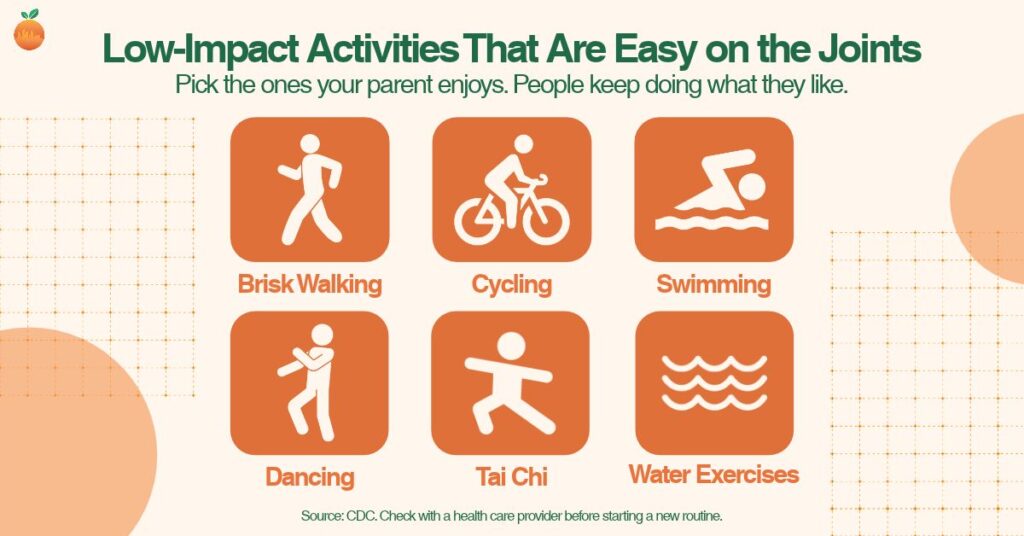
Low-impact choices protect painful joints. The CDC lists these options:²
- Brisk walking
- Cycling
- Swimming
- Dancing
- Tai chi
- Water exercises
For strength, use light weights or resistance bands that do not cause joint pain.² Pick activities your parent enjoys. People keep doing what they like.
Joint injuries can cause or worsen arthritis, especially osteoarthritis.³ Low-impact activity is easier on the joints. Protective gear and seat belts help prevent injuries.³
What If Pain Gets Worse After Starting a New Routine?
Some discomfort is normal at first. The CDC says mild pain, stiffness, or swelling can happen when starting a new routine.² Joint pain from activity should get better over time.² If it does not, contact a health care provider.²
Do not push through severe pain. Stop and call. A lighter plan or a different activity may fit better.
Does Heat or Cold Work Better for Joint Pain?
Cold works best for flare pain, and heat works best for aches. According to the Arthritis Foundation, cold narrows blood vessels to ease inflammation and swelling, while heat relaxes muscles and improves circulation. The National Council on Aging also lists heat and cold among the treatments that can help reduce pain. Ask the doctor which fits your parent.⁴¹
Pacing matters just as much. Spread tasks across the day so your parent can still do what matters most.⁴ Take breaks and change positions often.⁴ Plan the hard jobs for the best part of the day.
Can Losing Weight Ease Arthritis Pain?
Yes, for some people. Even a small amount of weight loss can reduce arthritis-related pain and disability in adults with overweight or obesity.³ The National Council on Aging says this is especially true for the hips and knees.¹
But weight changes in older adults need a doctor’s guidance. Unplanned weight loss can signal other problems. Ask the doctor what is safe and right for your parent before any changes.
Which Medicines and Aids Can Help?
Treatment options include oral pain relievers, topical creams, and joint injections.¹ The Arthritis Foundation names acetaminophen, nonsteroidal anti-inflammatory drugs (NSAIDs), and corticosteroid shots.⁴ NSAIDs also come as creams, gels, and patches.⁴
NSAIDs reduce inflammation, but they carry risks, so use them with caution.¹ All medicines should be used in consultation with a health care provider.¹ Our medication management guide can help you track what your parent takes.
Aids can help too. Braces and canes may improve pain, joint stability, and balance.¹ That matters, because balance affects fall risk.
What Other Support Can Help?
Medicine is only one part of care. Several other options can add relief:
- Physical or occupational therapy¹³
- Self-management education workshops recognized by the CDC³
- Counseling for stress or mood¹
- Relaxation, meditation, or biofeedback⁴
- Massage or acupuncture, which may also ease pain⁴
Self-management workshops build skills and confidence.³ If other approaches have not helped, the Arthritis Foundation suggests a pain clinic.⁴ Work with the health care team on a written pain plan.
How Can You Make the Home Easier on Painful Joints?
Small changes reduce daily strain. Try these in each room:
- Kitchen: Sit while preparing meals, and keep everyday items at waist height
- Bathroom: Add grab bars and a shower chair
- Bedroom: Choose a chair with firm arms to push up from
- Hallways: Add night lights and clear walkways
- Entrances: Keep a cane or walker within reach
Use our home safety checklist for a full room-by-room review. Share it with the therapist, too.
What Does a Joint-Friendly Week Look Like?
This sample week uses the CDC amounts. Adjust it with the doctor first. Skip any day that feels wrong and try again tomorrow.
- Monday: Three 10-minute walks
- Tuesday: Strength work with light bands, then a short rest
- Wednesday: Three 10-minute walks
- Thursday: Water exercise or a gentle swim
- Friday: Strength work with light bands, plus a balance activity
- Saturday: Dancing or tai chi
- Sunday: Rest, with gentle stretching if it feels good
That adds up to about 150 minutes of aerobic activity and two strength days. Every body is different. Small, steady sessions beat one big push.
How Does Arthritis Affect Mood?
Pain wears on mood. The CDC says physical activity can improve mood as well as pain and function.² Counseling for stress or mood is among the supports that the National Council on Aging lists.¹ Tell the doctor if your parent seems down, withdrawn, or worried. Mood is part of arthritis care.
What Should Caregivers Avoid?
Good intentions can backfire. Avoid these common mistakes:
- Pushing through severe pain
- Starting a new pain reliever, even an over-the-counter one, without asking the doctor¹
- Taking over every task, which can cost your parent independence
- Skipping follow-up visits, since symptoms may worsen if left unaddressed¹
- Assuming it is just aging and nothing can be done
What Questions Should You Ask the Doctor?
Bring a short list to the next visit. These questions cover the most important ground:
- Which type of arthritis does my parent have?
- How much activity is safe, and should we see a physical therapist first?
- Which pain relievers are safest, and what are the risks?
- Would heat, cold, a brace, or a cane help?
- Is a self-management workshop available nearby?
- When should we call the office, and when should we go to the emergency room?
Write the answers down. Share them with everyone who helps your parent.
How City Choice Home Health Care of Florida Supports Seniors With Arthritis
For more than two decades, City Choice Home Health Care of Florida has helped families in Boca Raton, Delray Beach, and Boynton Beach. We are Medicare-certified and have served more than 1,000 families. Skilled nursing and therapy, including physical, occupational, and speech therapy, can be provided at home.
Our caregivers help with bathing, dressing, meals, medication reminders, and rides to appointments. Overnight and 24-hour care are available when your parent needs more support. Read about in-home occupational therapy to see how it can make daily tasks easier.
Contact City Choice Home Health Care of Florida to talk through what your family needs.
Frequently Asked Questions
Is exercise safe for people with arthritis?
Yes. The CDC states that physical activity is safe for people with arthritis.² Start gently, build up slowly, and talk with a provider first if possible.²
How do you pace daily tasks with arthritis?
Spread tasks across the day so your parent can still do what matters most.⁴ Take breaks and change positions often.⁴
Is there a cure for osteoarthritis?
No. Osteoarthritis is the most common form of arthritis, and it has no cure. But symptoms can be managed.¹
Are NSAIDs safe for older adults?
NSAIDs reduce inflammation but carry risks, so they should be used with caution.¹ Ask the doctor before starting any pain reliever.¹
Move a Little, Often
Arthritis care in later life is not about pushing harder. It is about moving a little, often, with the right support. Start with one short walk, one home change, and one question for the doctor. Then build from there.
Related Articles
- Physical Therapy at Home in Palm Beach
- What Is In-Home Occupational Therapy?
- Medication Management for Seniors in Delray Beach
- Home Safety Checklist
- Fear of Falling in Delray Beach
Sources
1. National Council on Aging. How seniors can manage osteoarthritis symptoms. February 10, 2023. Accessed November 12, 2026. https://www.ncoa.org/article/how-seniors-can-manage-osteoarthritis-symptoms/
2. Centers for Disease Control and Prevention. About physical activity and arthritis. Accessed November 12, 2026. https://www.cdc.gov/arthritis/prevention/index.html
3. Centers for Disease Control and Prevention. Talking to patients about self-management. Accessed November 12, 2026. https://www.cdc.gov/arthritis/hcp/self-management/index.html
4. Arthritis Foundation. Managing your pain. Fact sheet. October 2025. Accessed November 12, 2026. https://www.arthritis.org/getmedia/bb18c322-39b9-40bf-99f4-6891197cea58/Fact-Sheet_Managing-Your-Pain-100825.pdf