 Family Caregiver Resources
Every family reaches this moment differently. For some, it’s a missed medication. For others, it’s a fall that almost happened, or a stove left on. Whatever the trigger, the conversation that follows is rarely easy, especially when you’re trying to figure out how to talk to elderly parents about accepting help. For us as adult children, we often replay moments like these for weeks. Always wondering if they said the right thing.
There’s no single script or approach that works for every parent or every relationship. What helps one family can fall flat for another. This guide isn’t a formula, it’s a collection of approaches worth considering, along with some honesty about why this is hard in the first place. These are tips and ideas we at City Choice collected over years of working with seniors and their families.
Why Parents Often Resist Help
Before any conversation about accepting help, it helps to understand what’s underneath the resistance. Refusal rarely comes from stubbornness alone.
Common fears include:
- Loss of independence. Accepting help can feel like losing control over one’s own life.
- Fear of being a burden. Many older adults would rather struggle quietly than feel like a problem for their family.
- Fear of losing the home. Some assume any outside help is the first step toward assisted living or a nursing facility.
- Discomfort with strangers. Having someone unfamiliar assist with personal tasks can feel invasive.
- Financial worry. Cost concerns often go unspoken but weigh heavily on the decision.
Recognizing which of these might apply to your specific parent can shape how you approach the conversation, though there’s rarely just one factor at play.
It’s Rarely Just About the Practical Need
It’s tempting to focus purely on logistics. When we say logistics, we mean the necessary routines like medication schedules, fall risk assessments, and meal prep. And while these are important, we noticed that the resistance itself is usually emotional, not practical. A parent who refuses a medication reminder service isn’t necessarily denying they forget pills. More often, they’re resisting what accepting that help seems to represent about their independence and identity. Our parents are much older and wiser than us and they know themselves they can struggle, but it’s taking that final step into acceptance. Keeping this in mind can shift how a conversation unfolds, even when the surface topic stays the same.
Talking to Elderly Parents About Accepting Help: What Tends to Help
There’s no guaranteed approach here, but a few patterns show up often in families who eventually find their way to “yes.”
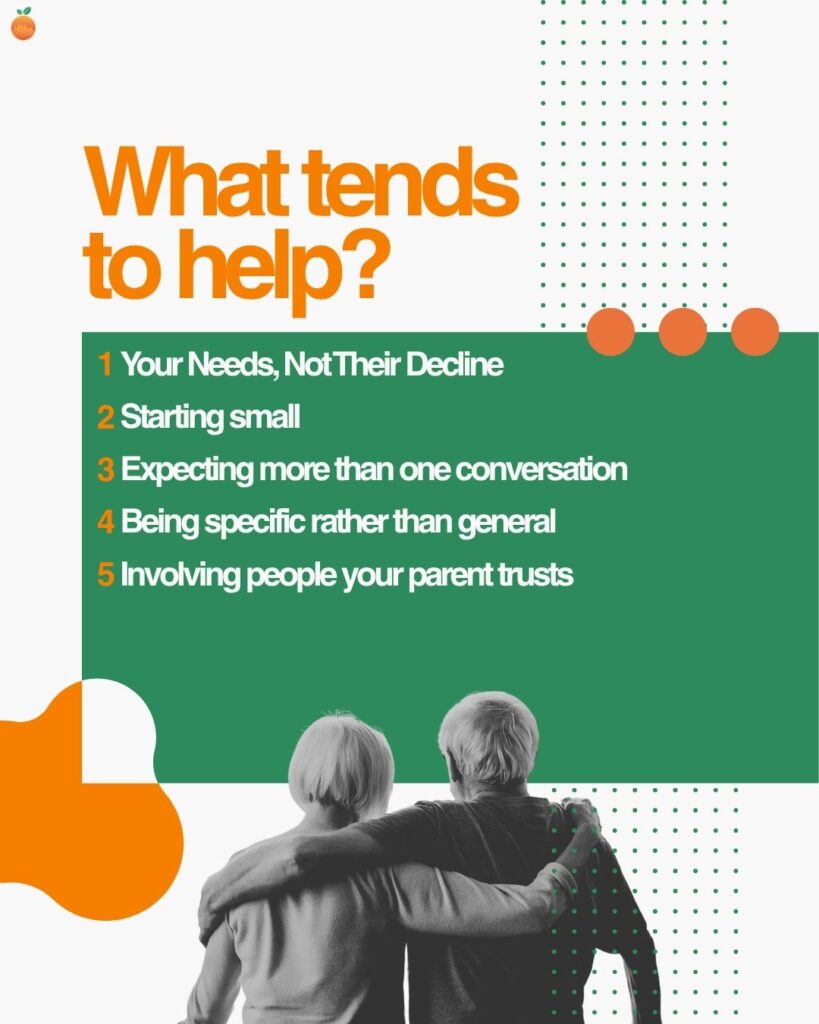
Framing it around your own needs, not their decline. This can also be called the “It’s not you, it’s me” approach. Trust us, while it may have not worked for your first break up, it can definitely help you’re your parents. Some families find it easier to say “This would give me peace of mind” rather than “You can’t manage on your own anymore.” The second version can feel like an accusation. The first invites collaboration instead.
Starting small. A trial run, someone coming for a few hours, a couple of mornings a week, often feels less threatening than a permanent arrangement. It’s not a lifelong commitment; it’s a chance to see how it feels.
Expecting more than one conversation. This rarely resolves in a single sitting. Many families find that the idea needs time to settle before a parent feels ready to reconsider.
Being specific rather than general. “I want to make sure someone checks on the stove” tends to land better than a broad statement like “You need help.” Specificity feels less like a judgment of someone’s whole life.
Involving people your parent trusts. Sometimes a suggestion lands differently coming from a sibling, a close friend, or even a physician, rather than the primary caregiver alone.
Treat it as a luxury. This is a big one. Your parents worked hard their whole life. They did everything correctly. Worked their jobs, raised their families, and saved for retirement. Now its time they accept some help and kick their feet up. Independence and letting someone else pick up the slack do not have to be mutually exclusive.
None of these approaches guarantees a yes. Some parents take longer than others. Some never fully come around, and families have to make difficult decisions anyway. That’s a hard reality worth naming honestly.
Timing Matters More Than People Expect
When you raise the subject can matter as much as how you raise it. A conversation right after a scary incident, a fall, a hospital visit, tends to happen from a place of fear on both sides. I wish we can offer some concrete advice of the perfect time, but a moment like this usually goes either way. It’s a fifty fifty chance whether the parent finally accepts the idea they need some help or push back ever further. Some families find it easier to revisit the topic once things have calmed down, when a parent doesn’t feel like they’re being cornered. There’s no perfect timing, but avoiding moments of high stress, when possible, tends to leave more room for an actual conversation instead of a defensive reaction.
A Few Example Openers
These aren’t scripts to follow word for word, more like starting points you can adapt to your own parent and your own voice.
- “I’ve been thinking about how we can make things easier, not because you can’t manage, but because I’d feel better knowing you have some backup.”
- “Would you be open to trying someone coming by a couple mornings a week, just to see how it feels? No long-term commitment.”
- “I want to talk about the stove situation, not because I think you can’t handle things, but because it’s been on my mind.”
Adjust these however feels natural. What matters more than the exact words is the tone: patient, collaborative, and free of ultimatums where possible. At the end of the day, you know your parents the best. But sincerity and honesty, letting them know that the respect you have for them has and will never go away.
When the Dynamic Flips: A Parent Who Leans on You Too Much
Sometimes the challenge isn’t resistance, it’s the opposite. A parent who calls constantly, expects immediate availability, or grows upset when you can’t drop everything.
This is a genuinely different, and often more emotionally complicated, situation. It’s not about convincing someone to accept help; it’s about protecting your own capacity to keep showing up sustainably.
A few things worth considering, though every family’s situation looks different:
- It’s possible to love someone deeply and still need boundaries around your time and energy.
- Boundaries aren’t about punishing a parent. They’re often what allows a caregiving relationship to continue without collapsing into resentment or burnout.
- Bringing in outside support isn’t a failure or an act of abandonment. For many families, it’s what makes sustainable care possible at all.
If this describes your situation, our guide on caregiver burnout goes deeper into recognizing the signs and finding a path forward before things reach a breaking point.
Related Article:
How a Professional Caregiver Can Change Both Conversations
Interestingly, bringing in outside help sometimes eases both problems at once. A parent who resists help from their adult child may accept it more easily from a professional, since it doesn’t carry the same emotional weight or history.
At the same time, having a caregiver in place gives the adult child room to breathe. The relationship can shift back toward being a son, daughter, or spouse, rather than a full-time care coordinator.
City Choice caregivers are trained to build trust gradually. A first visit might involve nothing more than companionship or light assistance, with more support added only as your parent becomes comfortable. There’s no pressure to commit to more than feels right.
Some families also find it helps to let the parent meet a caregiver before any formal arrangement begins, almost like an introduction rather than a hiring decision. This small shift, from “someone is coming to help you” to “would you like to meet someone,” can lower the emotional stakes considerably. It won’t work for every parent, but it’s worth considering as one more option among several.
Why Boynton Beach Families Talk to City Choice About This
These conversations are hard enough without adding pressure from a care provider. City Choice offers free consultations specifically so families can talk through their situation before deciding anything.
Our team has supported many Boynton Beach families through this exact transition, resistant parents, exhausted adult children, and everything in between. There’s no single right way to navigate accepting help as a family, but having someone who’s seen it before can make the process feel less isolating.
Many South Florida families juggle this conversation while also managing their own households, careers, and children. It’s a lot to carry alone. Talking to someone who works with these situations regularly, rather than figuring it out entirely from scratch, tends to ease at least some of that weight.
Frequently Asked Questions
Is there a “right” way to convince a parent to accept help?
Not really. What works varies enormously by relationship, personality, and circumstance. The approaches here are starting points for accepting help conversations, not guarantees.
What if my parent never agrees?
This happens more often than people expect. Some families continue the conversation gradually over months. Others eventually make decisions based on safety, sometimes without full agreement. This is a genuinely difficult situation without an easy answer.
Can a caregiver help even if my parent is initially resistant?
Often, yes. Many caregivers start with a light touch, like companionship or a few hours of help, and build trust from there rather than starting with a big commitment.
How do I know if I need to set boundaries versus just trying harder?
If you’re consistently exhausted, resentful, or neglecting your own needs, that’s usually a sign boundaries are needed, not more effort. Our caregiver burnout guide can help you assess where you stand.
Talk It Through With Us
Whether your parent is resisting help entirely, or you’re the one who needs support setting boundaries, you don’t have to figure this out alone. City Choice can talk through your specific situation, no pressure, no scripts, just an honest conversation.
Call 305-363-7755 or request a free consultation whenever you’re ready.
Related Articles