 Family Caregiver Resources
If you are caring for a loved one with dementia at home in Boca Raton, here is the short answer: you need a team, not just a family. Dementia progresses — and so must the level of support around it. This guide covers what sustainable dementia care actually looks like, when to ask for help, and what options are available to your family.
You did not sign up for this — not exactly. You opened your home, rearranged your life, and said yes when no one else could. And for a while, it worked. But dementia has a way of quietly moving the goalposts. What started as supervision has become around-the-clock vigilance. What used to feel manageable now feels impossible. And somewhere along the way, the guilt of considering other options started to feel heavier than the caregiving itself.
If this sounds familiar, you are not alone — and you are not failing. And you don’t have to figure it out without local support: there are more resources for families than most people realize
The Reality of Dementia Caregiving at Home
Dementia in Boca Raton families is unlike most other conditions navigated at home. It is progressive, unpredictable, and deeply personal. The person you are caring for is still there — but they are also, in many ways, not. That grief is real, and it sits alongside the exhaustion of managing someone who may wander at night, resist care, or need supervision every waking hour.
Research is consistent on this point: family caregivers of people with dementia experience some of the highest rates of burnout, depression, and physical health decline of any caregiver group. A significant percentage — studies suggest between 40 and 70% — develop clinically significant anxiety or depression during the caregiving period. This is not a personal failing. It is the predictable result of sustained, high-intensity caregiving without adequate support.
Caregiver burnout does not announce itself. It builds slowly — through disrupted sleep, social withdrawal, resentment, physical exhaustion, and the creeping sense that you have lost your own life in the process. By the time most caregivers recognize it, they are already running on empty.

Guilt Is Normal — But It Shouldn’t Make Decisions
One of the most common things family caregivers tell us is some version of: “I feel guilty even thinking about other options.”
That guilt is understandable. It comes from love. But it also tends to be built on a few assumptions worth examining.
The assumption that staying home is always better. For many people with dementia, a familiar home environment does provide comfort and continuity — especially in earlier stages. But as dementia progresses, the needs change. Wandering, incontinence, resistance to personal care, and behavioral changes can reach a point where the home environment is no longer the safest or most supportive setting — regardless of how much the family wants it to be.
The assumption that professional care means abandonment. Choosing a memory care facility or increasing professional support at home is not walking away. It is making a deliberate decision to ensure your loved one receives the level of care their condition now requires — care that is delivered by trained professionals in an environment designed specifically for it.
The assumption that you should be able to handle this. Dementia care is not a task that love alone can sustain indefinitely. It requires clinical skill, round-the-clock capacity, and relief — none of which any single family, regardless of how devoted, can provide indefinitely on their own.
Related Blog: Caregiver Burnout: Signs, Symptoms, and How to Prevent It.
Signs It May Be Time for More Support
There is no universal threshold — but there are signs that the current situation is no longer sustainable or safe.
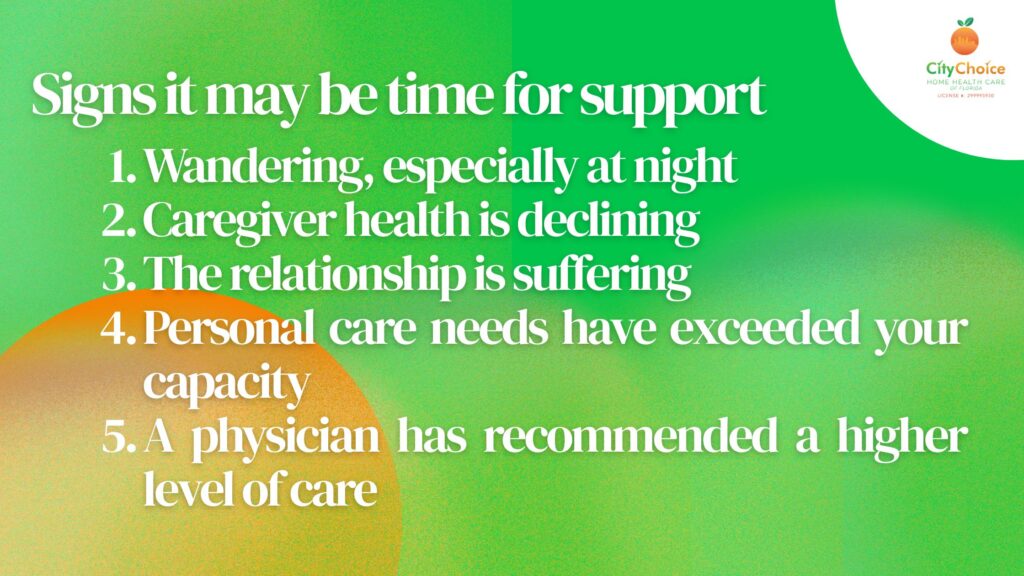
Wandering, especially at night
This is one of the most serious safety risks in dementia care. If your loved one has attempted to leave the home unsupervised, particularly during overnight hours, the risk of injury is real and significant. Managing wandering safely typically requires environmental modifications, specialized monitoring, and staffing that most homes cannot provide around the clock.
Caregiver health is declining.
If you are not sleeping, not eating well, withdrawing from your own social connections, or experiencing symptoms of depression or anxiety, you are no longer just managing your loved one’s health — you are also risking your own. Caregiver health matters, both for its own sake and because a depleted caregiver cannot provide safe care.
The relationship is suffering
Caregiving can erode the relationship between spouses, adult children, and siblings under the weight of stress and exhaustion. When the primary caregiver and their partner are in conflict, when frustration is being expressed directly at the person being cared for, or when the emotional environment of the household has become tense and strained — those are signs the current arrangement needs to change.
Personal care needs have exceeded your capacity
Bathing, incontinence care, repositioning, and managing resistance during personal care are physically demanding and emotionally difficult. Not wanting to provide this type of care is not selfish — it is honest. Recognizing the boundary between what you can offer and what your loved one needs is one of the most important things a caregiver can do.
A physician has recommended a higher level of care
When a doctor says it is time for memory care or a higher level of support, that recommendation deserves serious weight. Physicians who work with dementia patients have seen the trajectory of this disease. Their recommendation is clinical, not a judgment of your caregiving.
Related Blog: Difference Between Home Care vs. Home Health Care
What Are Your Options?
If the current situation is no longer sustainable, there are several directions worth exploring — not as a binary choice between “home” and “facility,” but as a spectrum of support. Families also have access to county-level programs that can lower the cost of getting help.
Increase in-home professional support
For families who want to keep their loved one at home, increasing care hours can make a real difference. A licensed home health aide or personal care attendant can help with daily tasks. That includes bathing, incontinence care, and supervision. These trained aides can take those tasks off the family caregiver’s plate. They can also provide consistent support throughout the day or night.
Skilled home nursing visits
If your loved one is enrolled in hospice or qualifies for home health services, they can receive regular skilled nursing visits. These visits provide clinical oversight. They also help manage behavioral symptoms, medication, and safety concerns related to dementia. City Choice’s clinical team serves the area directly. That means visits can be scheduled without the delays common with agencies covering a wider region.
Adult day programs
Adult day programs offer structured daytime programming — activities, social engagement, meals, and supervision — in a group setting, while allowing the person to return home in the evenings. For working caregivers or those who need daytime relief, these programs can be a lifeline.
Respite care
Respite care provides temporary relief for family caregivers — either through in-home respite (a trained caregiver comes to the home so the family can take a break) or through short-term inpatient placement at a care facility. It is a covered benefit under the Medicare hospice program, though placement availability for patients with specific safety needs, such as wandering, may require additional coordination.
Palm Beach County also runs its own respite support. It’s offered through the Area Agency on Aging of Palm Beach/Treasure Coast’s Alzheimer’s Disease Initiative. The program provides free, community-based respite and caregiver training. It’s available to county residents caring for someone with a diagnosed or suspected memory disorder. If you have encountered barriers to respite placement, speak with your hospice coordinator or a care manager. They can help you explore these county-level options.
Memory care placement
Memory care facilities are specifically designed for individuals with dementia. They offer secure environments that address wandering risk, staff trained in dementia-specific care, structured programming, and 24-hour supervision. For families who have reached the limits of what home care can safely provide, memory care placement is not a last resort — it is an appropriate, loving response to a condition that has outgrown the home setting.
Related Blog: Read About Skilled Nursing at Home
Local Support for Boca Raton Caregivers
You don’t have to navigate this alone, and you don’t have to pay out of pocket for every form of support. A few Palm Beach County resources worth knowing about:
- Area Agency on Aging of Palm Beach/Treasure Coast — connects local residents to community programs, benefits counseling, and its Alzheimer’s Disease Initiative, which offers free respite care and caregiver training for families caring for someone with a memory disorder.
- Ruth & Norman Rales Jewish Family Services (Boca Raton) — offers caregiver education and support sessions, including guidance on home safety and coping strategies, funded in part through the Florida Department of Elder Affairs.
- Your loved one’s hospice or home health coordinator — can help you access Medicare-covered respite benefits and connect you with a geriatric care manager or social worker for a formal needs assessment.
For the Caregiver Who Feels Like They’re Failing
You are not failing. You are exhausted — and there is a difference.
Dementia caregiving at the level most families are providing it is one of the most demanding things a person can do. It is physically taxing, emotionally destabilizing, and relentless. The fact that you are still showing up, still asking questions, still looking for ways to do better — that is not failure. That is love under enormous pressure.
Getting help — whether that means more in-home support, a day program, respite care, or a transition to memory care — does not diminish what you have done. It extends it. It ensures your loved one continues to receive excellent care, even when your own capacity has reached its limit.
And it gives you back something you need too: rest, space, and the ability to show up as a spouse, a sibling, a child — not just a caregiver.
Talking to Someone
If you are at the point where you are not sure what to do next, the most important thing is not to make that decision alone. A social worker, geriatric care manager, or home health coordinator can assess your loved one’s current needs, help you understand what level of care is appropriate, and guide your family through the options available to you.
You do not have to have it figured out before you make the call. That is what the call is for.
How City Choice Can Help
City Choice Home Health Care of Florida provides skilled nursing, personal care, and home health services for individuals with dementia and other complex conditions throughout Boca Raton, Delray Beach, and Boynton Beach. We work with local families who are navigating exactly these decisions — helping them understand their options, coordinate care, and find sustainable support for their loved one and themselves.
If you are a Boca Raton family caregiver who is running out of runway, we would like to help. Call us at 305.363.7755 or email info@citychoiceflorida.com. Our clinical team is available 24/7.
Frequently Asked Questions
Is it wrong to consider memory care for a loved one with dementia?
No. Memory care facilities are specifically designed for individuals whose dementia has progressed to the point where home care can no longer safely meet their needs. Choosing memory care is a clinical decision, not a moral one — and for many families, it results in a better quality of life for their loved one and a healthier relationship between the family and the person they care for.
What if my loved one says they never want to go to a facility?
Many people express this preference before dementia progresses. As the disease advances, however, the person may lack the capacity to safely make care decisions. In those situations, families and physicians must weigh the person’s previously expressed wishes alongside their current clinical needs and safety. A geriatric care manager or social worker can help families navigate this conversation.
Can I get help at home before considering a facility?
Absolutely. Increasing in-home care hours, adding overnight supervision, or enrolling in a day program are all options that can extend the viability of home care. The right level of support depends on your loved one’s specific needs and your family’s capacity. A City Choice home health coordinator can help assess what makes sense.
What is caregiver burnout and how do I know if I have it?
Caregiver burnout is a state of physical, emotional, and mental exhaustion that develops when caregiving demands consistently exceed the caregiver’s resources and support. Signs include chronic fatigue, social withdrawal, resentment, difficulty experiencing positive emotions, and declining physical health. If you recognize these signs in yourself, speaking with a physician or mental health professional is an important first step.
Does Medicare cover home care for dementia patients in Boca Raton?
Medicare covers skilled home health services — including nursing visits and therapy — for eligible homebound patients whose physician certifies a need for skilled care. Personal care and supervision alone do not typically qualify for Medicare coverage, but may be covered under Medicaid for eligible patients. A City Choice home health coordinator can help you understand what your specific plan covers.