 Senior Health Wellness
Your father reaches for the wall on the way to the kitchen. He says he is fine. Last month he did not need the wall at all. A small change like this is easy to miss, and it is a good time to act.
Balance exercises for seniors can help build steadiness before a fall happens. This guide explains which moves to start with and how to practice them safely. You will also find a step-by-step progression you can follow, and a quick safety setup for each session.
Why Do Balance Exercises for Seniors Matter?
Balance exercises for seniors help older adults stay steady on their feet during daily activities such as climbing stairs. The National Institute on Aging says more than 2 million older Americans go to the emergency room each year because of fall-related injuries. Good balance is one of the most useful things a family can protect.¹
Strength and balance training belongs in a fall prevention plan.² MedlinePlus says exercise can make muscles stronger, improve balance, and increase how long you can stay active.⁴ The Office of Disease Prevention and Health Promotion suggests looking for balance classes at a community center or senior center.³
What Is the Easiest Way to Start?
Start with three simple moves: stand on one foot, walk heel to toe, and walk in a straight line with one foot in front of the other. Use a sturdy chair or the wall for support in the beginning. You can practice almost anytime, anywhere, and as often as you like, as long as something sturdy is nearby.¹
Keep it small at first. A few careful minutes beat one long, tiring session. Stop if anything hurts or feels wrong, and tell the doctor.
Related Study/Source: The National Institute on Aging notes that lower-body exercises strengthen the legs and ankles. It lists the back leg raise, side leg raise, knee curl, and toe stand.¹ Strong legs support steady balance.
How Do You Practice Each Balance Exercise?
The sources name the moves but do not give counts, so ask a doctor or physical therapist how long to hold each one. These are the basics:
- Stand on one foot. Hold the chair with both hands first.¹
- Walk heel to toe. Place the heel of one foot right in front of the toes of the other.¹
- Walk in a straight line. Put one foot directly in front of the other.¹
- Do leg raises, knee curls, and toe stands to build leg and ankle strength.¹
Move slowly. Keep your eyes forward and your back tall. Let the chair do the work at first.
How Do You Make Balance Exercises Harder Over Time?
Make balance exercises harder in small steps. Hold a sturdy chair with both hands first. Then hold with one hand, then one finger, then no hands. If you are very steady, you may try the exercises with your eyes closed, once a therapist agrees. Move on only when the current step feels easy and safe.¹
Never rush the ladder. Staying on one step for a few weeks is fine. Progress is not a race.
What Does a Simple Progression Plan Look Like?
Use this ladder as a guide, and adjust it with a physical therapist:
- Step 1: Hold a sturdy chair with both hands during each move
- Step 2: Hold with one hand when you feel steady¹
- Step 3: Hold with one finger¹
- Step 4: Let go, while the chair stays within reach¹
- Step 5: Try a move with eyes closed only if you are very steady, and only after the therapist agrees¹
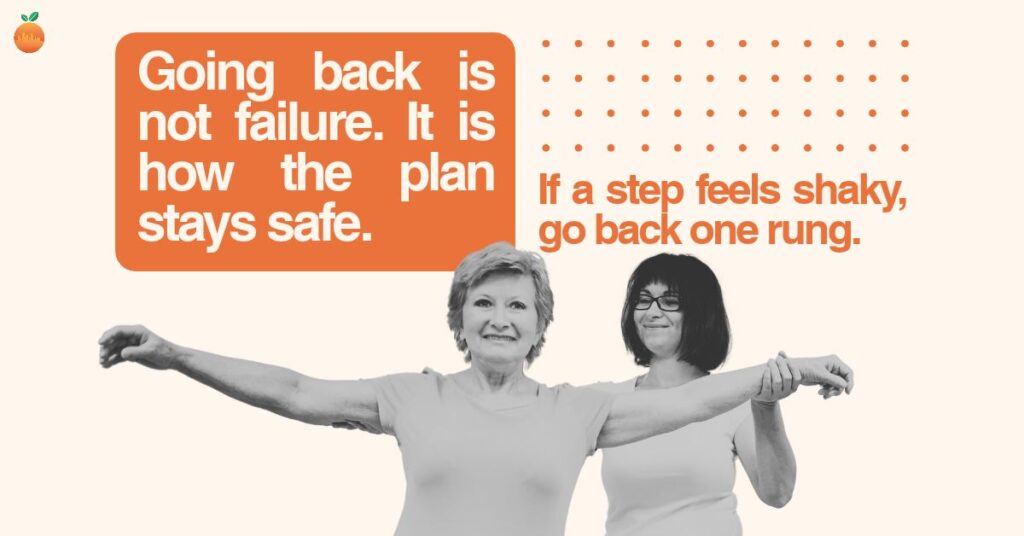
Add one change at a time. If a step feels shaky, go back one rung. Going back is not failure. It is how the plan stays safe.
How Do You Set Up a Safe Space?
Most slips happen because of the room, not the exercise. Check these items before each session:
- Keep a sturdy chair or a firm wall within reach¹
- Wear shoes with non-slip soles, even inside the home³
- Clear clutter, remove small rugs or tape them down, and add non-slip mats and stair railings³
- Make sure lighting is bright, especially on the stairs³
- Have someone nearby for the first few sessions, if you can
Our home safety checklist covers every room. Use it to find hazards before they find your parent.
What About Tai Chi?
The Office of Disease Prevention and Health Promotion describes tai chi as a mind-body exercise that can help with balance.³ Look for classes at a local community center or senior center.³ Ask the doctor whether a class suits your parent.
Choose a class with a slow pace and a clear teacher. Start with a short visit, and see how your parent feels afterward.
Should You See a Doctor Before You Start?
Yes. Talk to the doctor before your parent starts any balance routine, especially after a fall or if your parent feels unsteady. Bring a list of all medicines, including over-the-counter ones, to a doctor or pharmacist. Ask for a medicine review, since it is part of fall prevention, and get your parent’s eyes checked every year.²³
The Health in Aging Foundation adds that fall risk can come from many sources.² It lists vision problems such as cataracts, medicines that need review, and low vitamin D.² If risk is high, the foundation advises seeing a geriatrician or another health professional trained in geriatrics.² Our medication management guide can help you prepare for that visit.
When Should a Physical Therapist Get Involved?
A therapist can check your parent’s balance, choose safe moves, and set the pace. This helps most after a fall or a hospital stay. It also helps when your parent has pain, weakness, or fear of falling.
Our physical therapy at home guide explains what a visit looks like. You can also read about fear of falling in Delray Beach if worry is holding your parent back.
What Else Lowers the Risk of Falls?
Exercise is one piece. These steps work alongside it:
- Get a yearly eye exam³
- Treat vision problems such as cataracts²
- Complete a home safety assessment²
- Review medicines and adjust them if needed²
- Take vitamin D if levels are low²
Fall prevention works best as a set of small habits. No single step does it all.
When Should You Stop and Call for Help?
Stop an exercise if it causes pain, dizziness, or problems breathing.⁴ Sit down and rest. Talk with a doctor, nurse, or physical therapist before you continue.⁴
Call 911 after a fall with a head injury, severe pain, or trouble getting up. Do the same for chest pain, confusion, or any sign of stroke.
How City Choice Home Health Care of Florida Supports Safe Movement
For more than two decades, City Choice Home Health Care of Florida has helped families in Boca Raton, Delray Beach, and Boynton Beach. We are Medicare-certified and have served more than 1,000 families. Skilled nursing and therapy, including physical, occupational, and speech therapy, can be provided at home.
Our caregivers help with bathing, dressing, meals, medication reminders, and rides to appointments. Overnight and 24-hour care are available when your parent needs more support. Read what to expect in a home care assessment before you call.
Contact City Choice Home Health Care of Florida to talk through what your family needs.
Frequently Asked Questions
How often should seniors do balance exercises?
The National Institute on Aging says you can practice almost anytime, anywhere, and as often as you like, as long as something sturdy is nearby to hold.¹
What is the safest balance exercise for a beginner?
Standing on one foot while holding a sturdy chair with both hands is a safe start.¹ Add support, and ask a therapist about timing.
Is Tai Chi good for balance?
The Office of Disease Prevention and Health Promotion calls tai chi a mind-body exercise that can help with balance.³ Ask the doctor first.
Do I need a doctor’s approval?
Yes. Talk to the doctor before your parent starts any balance routine, and mention any falls or unsteadiness. Bring a list of all medicines, including over-the-counter ones.³
Steady Steps Start Small
Balance exercises for seniors do not need special gear. They need a sturdy chair, a safe room, and a plan. Start with one move, one rung, and one question for the doctor. Then build from there.
Related Articles
- Fear of Falling in Delray Beach
- Home Safety Checklist
- Physical Therapy at Home in Palm Beach
- Medication Management for Seniors in Delray Beach
- What to Expect in a Home Care Assessment
Sources
1. National Institute on Aging. Improve your balance. Go4Life. Archived February 14, 2013. Accessed November 12, 2026. https://webarchive.library.unt.edu/web/20130214144246/http://go4life.nia.nih.gov/sites/default/files/Improve_Your_Balance.pdf
2. American Geriatrics Society, Health in Aging Foundation. Fall prevention: care and treatment. HealthInAging.org. Accessed November 12, 2026. https://healthinaging.org/a-z-topic/fall-prevention/care-treatment
3. U.S. Department of Health and Human Services, Office of Disease Prevention and Health Promotion. Lower your risk of falling. MyHealthfinder. Reviewed November 2024; content updated August 24, 2026. Accessed November 26, 2026. https://odphp.health.gov/myhealthfinder/healthy-living/safety/lower-your-risk-falling
4. MedlinePlus Medical Encyclopedia, National Library of Medicine. Exercises to help prevent falls. Reviewed June 4, 2026. Accessed November 26, 2026. https://medlineplus.gov/ency/patientinstructions/000493.htm