 Senior Health Wellness
Your mother has worn the same soft slippers for years. Lately she shuffles, and she skips the walk to the mailbox. You glance down and see a red spot on her heel that she never mentioned.
Foot care for elderly adults is easy to overlook, yet small problems can grow fast. This guide explains what to check, how to wash and trim, and how to choose shoes. You will also find a two-minute daily foot check and a clear list of signs that mean “call the doctor today.”
Why Does Foot Care for Elderly Adults Matter?
Foot care for elderly adults matters because wear and tear, disease, poor circulation, badly trimmed toenails, and ill-fitting shoes can all harm the feet. Problems with the feet can also be the first sign of arthritis or diabetes. A few minutes of daily attention helps families catch trouble early, before a small sore becomes a serious one.¹
Feet carry the whole body. When they hurt, people walk less, balance worsens, and falls become more likely. That is why feet belong in every senior health plan.
What Is a Two-Minute Daily Foot Check?
Check your loved one’s feet every day, even if they feel fine. Look at the tops, soles, heels, and between the toes. Use a mirror to see the bottoms. Watch for cuts, redness, swelling, blisters, ingrown toenails, and changes in the skin or nails. Write down anything new and share it with the doctor.¹²
Make it part of the routine, like brushing teeth. Do it after a bath or before bed, when the feet are bare. Ask your parent how the feet feel too. Pain, numbness, or tingling count as findings.
Related Study/Source: The Centers for Disease Control and Prevention explains that diabetes can cause nerve damage and poor blood flow, which can lead to foot ulcers.² Reduced feeling means small injuries may go unnoticed.² A daily look protects what your parent cannot feel.
How Should You Wash and Dry Older Feet?
Keep the feet clean and dry. Pay special attention to the spaces between the toes.¹ The CDC advises washing daily in lukewarm water and avoiding long soaks.² Dry thoroughly, including between the toes.²
Use mild soap and a daily moisturizer for dry skin.¹ Apply lotion to the tops and bottoms of the feet. Keep it out from between the toes to lower infection risk.² Go easy on oils in bath water, since they make feet and tubs slippery.¹
How Do You Trim Toenails Safely?
Trim toenails straight across so the corners do not dig into the skin. Use clippers made for toenails, and smooth sharp edges with a file. Badly trimmed nails can harm the feet. If your loved one cannot reach the feet or has diabetes, ask a podiatrist for help. Cut slowly and in good light.¹²
Do not cut into the corners. Avoid scissors that are too small for the job. Stop and call the doctor if you see redness, swelling, or drainage near a nail.
What Shoes and Socks Protect Aging Feet?
Foot size can change with age. Get measured before buying shoes, ideally late in the day when feet are largest.¹ Fit the larger foot, try on both shoes, and walk in them.¹ Stand up in the shoe to check for room at the toes.¹ Do not count on tight shoes stretching.¹
Choose low heels and a soft upper.¹ The Office of Disease Prevention and Health Promotion also advises non-slip soles, even inside the home.³ Always wear shoes and socks or slippers, even inside, to avoid injury.² Check inside each shoe for small objects before putting it on.²
Flip-flops and bare feet are common in South Florida. They offer little protection, so closed shoes are a safer everyday choice.
What Are the Most Common Foot Problems?
Several problems show up often in later life:¹
- Athlete’s foot causes dryness, redness, itching, and peeling. Creams or powders can help. See a doctor if there is no improvement after two to four weeks
- Corns and calluses come from pressure. Better-fitting shoes or non-medicated pads can help. Do not shave them off, because that can cause infection
- Bunions are swollen, tender joints at the base of the big toe. Wide-toed shoes, padding, or pain relievers may help
- Hammertoes are toes bent back by shortened tendons. More room in the shoe can help
- Warts are viral growths that can spread. See a doctor for treatment
Surgery is sometimes needed for bunions and hammertoes.¹ Ask the doctor before trying anything strong at home.
How Does Poor Circulation Affect the Feet?
Diabetes and peripheral artery disease reduce blood flow to the feet. Minor cuts or bruises can then become infected more easily.¹ A sore that will not heal needs a doctor.¹
Simple habits help circulation. Prop the feet up when sitting, stretch, and walk.¹ Stand and move during long periods of sitting, and do not smoke.¹ A warm foot bath or gentle massage may also help.¹ Skip the foot bath if your parent has reduced feeling, because the CDC advises lukewarm water and no soaking.²
Our wound care guide explains what care at home can look like for a slow-healing sore.
What Extra Care Does Diabetes Require?
People with diabetes should check their feet every day.¹ Never let them walk barefoot, even indoors.² Trim nails straight across, and ask a podiatrist for help if your parent cannot reach the feet.²
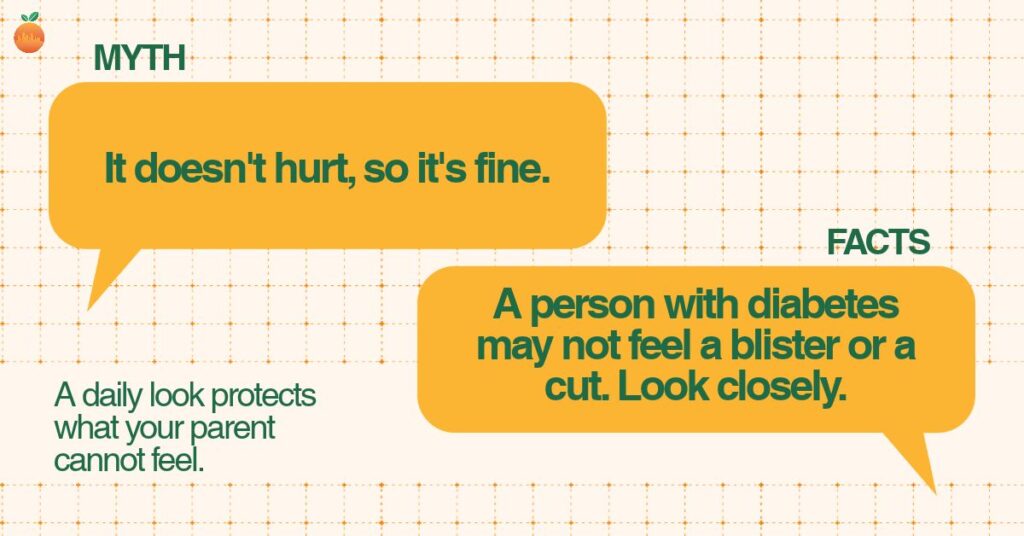
Diabetes also changes what you can see. A person may not feel a blister or a cut. Look closely, and do not rely on “it doesn’t hurt.”
When Should You Call the Doctor or a Podiatrist?
Call the doctor about foot pain, numbness, color or temperature changes, sores, or infections, and do not wait for the next appointment. A sore that will not heal also needs care. Swelling in the feet or ankles that does not go away calls for a checkup too. Start with the family doctor, or see a podiatrist.¹²
A podiatrist is a doctor who specializes in feet.¹ Bring a list of medicines and a note about any new symptoms. If a foot turns pale, cold, or very painful, or you see spreading redness with fever, seek urgent care or call 911.
What Does a Weekly Foot Plan Look Like?
Keep it light. This plan fits into any week:
- Every day: Look at both feet, wash in lukewarm water, dry between the toes, and moisturize
- Every day: Check shoes for objects, and put on clean, dry socks
- Once a week: Trim nails straight across, if safe
- Once a week: Check shoes for worn soles or rubbed spots
- Every visit: Show the doctor any new sore, color change, or pain
Share the plan with everyone who helps your parent. Consistent care matters more than perfect care.
How City Choice Home Health Care of Florida Supports Healthy Feet
For more than two decades, City Choice Home Health Care of Florida has helped families in Boca Raton, Delray Beach, and Boynton Beach. We are Medicare-certified and have served more than 1,000 families. Skilled nursing and therapy, including physical, occupational, and speech therapy, can be provided at home.
Our caregivers help with bathing, dressing, meals, medication reminders, and rides to appointments. Overnight and 24-hour care are available when your parent needs more support. Read what to expect in a home care assessment before you call.
Contact City Choice Home Health Care of Florida to talk through what your family needs.
Frequently Asked Questions
How often should an older adult’s feet be checked?
Every day. The CDC says to check your feet every day, even if they feel fine.²
Should seniors with diabetes ever go barefoot?
No. The CDC advises avoiding walking barefoot at any time and wearing shoes and socks or slippers, even inside.²
How do you trim an older adult’s toenails?
Trim straight across so the corners do not dig in.¹² Ask a podiatrist for help if you cannot reach the feet.²
Can I cut off a corn or callus?
No. Shaving them off can lead to infection.¹ Better-fitting shoes or non-medicated pads can help.¹
Small Checks, Big Protection
Foot care for elderly adults does not take special skill. It takes a daily look, clean dry skin, careful nails, and shoes that fit. Start tonight with a two-minute check. Then build the habit.
Related Articles
- Wound Care in Palm Beach
- Home Safety Checklist
- Fear of Falling in Delray Beach
- Medication Management for Seniors in Delray Beach
- What to Expect in a Home Care Assessment
Sources
1. National Institute on Aging. Foot care. Archived September 15, 2012. Accessed November 12, 2026. https://webarchive.library.unt.edu/web/20120915102432/http://www.nia.nih.gov/health/publication/foot-care
2. Centers for Disease Control and Prevention. Your feet and diabetes. Accessed November 12, 2026. https://www.cdc.gov/diabetes/diabetes-complications/diabetes-and-your-feet.html
3. U.S. Department of Health and Human Services, Office of Disease Prevention and Health Promotion. Lower your risk of falling. MyHealthfinder. Reviewed November 2024; content updated August 24, 2026. Accessed November 26, 2026. https://odphp.health.gov/myhealthfinder/healthy-living/safety/lower-your-risk-falling