 Services
You just left the hospital. Getting to a clinic feels impossible right now. In-home therapy may already be part of your discharge plan.
A therapist comes to you instead. This works well for patients who cannot leave home easily. Many families researching home care in Boca Raton do not realize skilled nursing and in-home therapy can happen together, under one coordinated plan.
This guide explains how home care physical therapy works after a hospital stay, what a visit looks like, and how City Choice Home Health Care of Florida combines it with skilled nursing for patients recovering in Boca Raton.
Related Article: What Happens After Hospital Discharge: Why Home Care Is the Next Step
What Counts as Home Care Physical Therapy?
This type of care is licensed rehabilitation delivered inside your own home. A therapist evaluates your strength, balance, and gait during the first visit. They build your plan around your actual home, not a generic gym setup.
The first 30 days after discharge matter most. Patients either regain function during this window, or they lose it. In-home rehabilitation exists to protect that window.
Related Guide: Home Care vs. Home Health Care: A Complete Guide for Families and Caregivers
What Does “Homebound” Mean for Home Health Care Physical Therapy?
This word confuses more families than any other term on this page. Homebound does not mean bedridden. It does not mean you can never leave the house.
Medicare defines homebound in two parts. First, leaving home takes real effort, usually because you need a walker, a wheelchair, or another person’s help. Second, your doctor confirms leaving home is medically difficult or inadvisable right now.
A patient in Boca West who can be driven to church on Sunday still qualifies. So does someone in a gated community off Powerline Road who uses a walker after a fall. Homebound is a functional standard. It is not a strict lockdown.
This standard opens the door to skilled therapy for most post-surgical and post-hospital patients in Boca Raton.
What Does a Physical Therapy Visit at Home Look Like?
Sessions usually run 45 to 60 minutes. Visits happen two or three times a week when therapy starts. The frequency tapers as you improve.
The first visit focuses on your home, not exercise. Your therapist checks for loose rugs, slick tile floors, and awkward thresholds. They look at how you currently move from bed to chair.
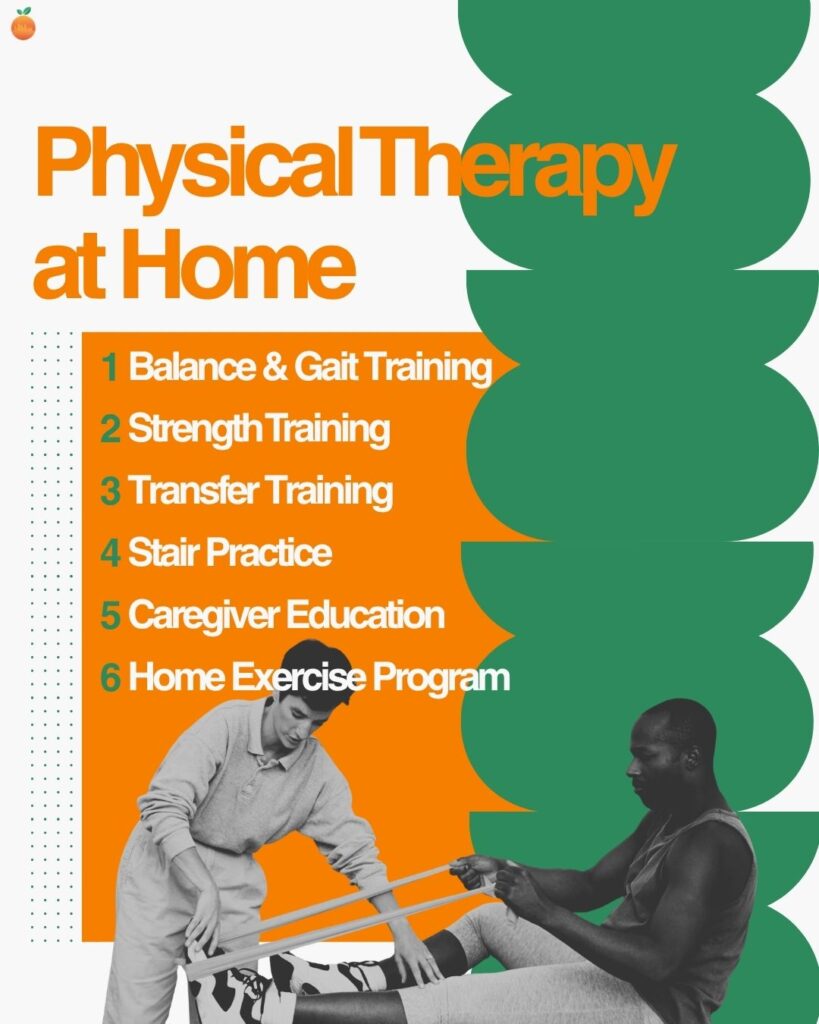
A typical in-home visit includes several things:
- Balance and gait training, often practiced with a cane or walker
- Strength work using furniture already in your home
- Transfer training, moving safely from bed to chair and chair to standing
- Stair practice, matched to your actual staircase and handrail
- Caregiver education, so a spouse or adult child can assist safely
- A home exercise program you continue between visits
Your therapist reports your progress to your doctor. When a nurse is also involved, both providers coordinate around one shared plan.
Related Article: In-Home Occupational Therapy: What It Is and Who It’s For
Mobility Milestones After a Hospital Stay
Every recovery timeline looks different. Diagnosis, age, and baseline health all shape the pace. A typical progression looks something like this:
- Week 1: Transfer safely from bed to chair. Stand unassisted for 30 seconds.
- Week 2: Walk to the bathroom independently with a walker or cane.
- Weeks 3–4: Climb four to six stairs using a handrail.
- Weeks 5–6: Walk outdoors on a paved surface for five minutes.
Boca Raton adds one wrinkle here. Walking outside in July strains the body differently than walking outside in October. Heat and humidity add cardiovascular load on top of the mobility challenge itself. Many therapists shift outdoor sessions to early morning during summer months. Others use a covered lanai instead.
Does Home Health Care and Physical Therapy Reduce Hospital Readmissions?
Yes, and the research backs this up clearly. A 2020 rapid review in the Journal of Comorbidity studied home care rehabilitation across North America and Europe.
One study inside that review followed nearly 100,000 Ontario home care clients with musculoskeletal conditions. Clients who received rehabilitation at home faced a meaningfully lower risk of hospitalization or long-term care admission. They were also more likely to be discharged because they finished recovering, not because their condition worsened.
A separate chart review cited in the same paper tracked home health patients recovering from orthopedic diagnoses. Most patients improved their toileting independence. A large share also improved their ability to transfer and walk during a single home health episode.
The broader pattern held across nearly every study the reviewers examined. Functional improvement followed rehabilitation delivered at home, regardless of how researchers counted each patient’s chronic conditions.
Preventing the Fall That Sends You Back to the Hospital
Your therapist’s first job is risk reduction, not just strength building. Clearing walking paths comes first. Checking your footwear comes next. Flagging a step-down into a sunken living room follows, a common feature in older South Florida homes.
Whoever is around you learns fall-prevention basics too. A spouse, an adult child, or a caregiver picks up how to spot a near-fall before it becomes an emergency room visit.
Related Article: Caregiver Burnout: Signs, Symptoms, and How to Prevent It
Conditions Treated With Physical Therapy at Home
Doctors most commonly order this care after:
- Hip or knee replacement surgery
- A fall resulting in fracture or major weakness
- Stroke, with reduced strength or coordination on one side
- Hospitalization for heart failure, COPD, or another chronic condition
- Parkinson’s disease or another condition affecting balance and gait
- General weakness following any multi-day hospital stay
If your doctor has ordered home health after discharge, and you meet the homebound standard, therapy is almost always part of that plan.
Related Article: Parkinson’s Home Care Support in Delray Beach
Related Article: Speech Therapy at Home After a Stroke: What to Expect
How Home Care Physical Therapy Agencies Combine Nursing and Therapy
Most agencies send a therapist and stop there. City Choice Home Health Care of Florida does something different for surgical patients.
We coordinate a skilled nurse managing wounds, medication, and post-surgical monitoring. At the same time, a physical therapist rebuilds strength and mobility. Both providers work from one shared plan.
This matters more than it sounds. A patient six days out from hip surgery juggles an incision, a new medication schedule, swelling, and exercises, often all at once. When the nurse and the therapist communicate, small problems get caught early. A swelling leg gets flagged sooner. A pain spike adjusts the therapy plan. A medication side effect that worsens balance gets noticed immediately.
That coordination separates a Medicare-certified home health agency from a general referral service.
Related Article: Skilled Nursing at Home: What Medicare Will and Won’t Cover
Is Physical Therapy Home Care Near Me Covered by Medicare?
For homebound patients with a physician’s order, this care is typically covered under Medicare Part A or Part B. Most patients pay nothing out of pocket for covered visits.
Coverage generally requires three things:
- A doctor certifying that you are homebound
- A documented need for skilled, intermittent care
- A physician’s order for home health services
City Choice Home Health Care of Florida is a Medicare-certified home health agency, AHCA #299994127. We bill Medicare directly for covered visits. Private-pay options exist too, for patients who want therapy at home but do not meet the homebound standard.
Related Article: Rehab Insurance Ran Out? Here’s What Boca Raton Families Need to Do Next
Related Article: How Much Does Home Care Cost in Florida?
Common Misconceptions About This Type of Care
“I could just do the exercises myself.” A licensed therapist assesses gait, joint mobility, and fall risk that most family members cannot catch. They adjust your program as you progress, not from a printed handout.
“It’s only for surgery recovery.” This type of care also manages chronic conditions and prevents falls before they happen.
“It hurts.” Physical therapy reduces pain. It should not add to it. A good therapist checks your comfort constantly and adjusts the plan.
“The benefit disappears when visits end.” This kind of care teaches independence. You keep the gains long after your last visit, because you learned them inside your own home.
How Long Does Physical Therapy in Home Care Last?
Most patients receive six to eight weeks of visits. A serious or progressive condition may need more. A patient recovering quickly from a straightforward procedure may need only a few visits, plus a home exercise program.
Visit frequency usually starts at two to three times weekly. It tapers as you stabilize. Your therapist and physician adjust the schedule based on your actual progress.
In-Home Therapy for Boca Raton Snowbirds
Many City Choice Home Health Care of Florida patients are seasonal residents. They recover from a procedure at Baptist Health Boca Raton or Delray Medical Center while staying here for winter. Often, they do not have their usual support network nearby.
Coordinating skilled nursing and in-home rehabilitation matters even more in that situation. There is often no adult child down the street to fill the gaps between visits. Mention this to our intake team directly, so we can plan your visit schedule accordingly.
Where We Provide Physical Therapy at Home in Palm Beach County
City Choice Home Health Care of Florida delivers physical therapy at home across three communities. If you are comparing options for home care in Palm Beach, each community here has its own hospitals, housing styles, and recovery needs. Your therapist adapts to the specific place you call home.
Home Care in Boca Raton
Boca Raton patients often discharge from Baptist Health Boca Raton or West Boca Medical Center. Many live in condo communities like Boca West and Broken Sound, or gated neighborhoods off Powerline Road. Therapists here are used to elevators, narrow hallways, and HOA-managed common areas. Families searching for home care in Boca Raton usually start with a hospital discharge like this.
Home Care in Delray Beach
Delray Beach patients frequently discharge from Delray Medical Center. Large 55-plus communities like Kings Point and Andover shape a lot of the recovery planning here. Therapists build visit schedules around clubhouse shuttles, golf cart paths, and single-story layouts common in these communities. Home care in Delray Beach often starts the same way, right after a hospital stay.
Home Care in Boynton Beach
Boynton Beach patients often recover near Bethesda Hospital East. Active-adult communities such as Hunters Run and the Valencia neighborhoods make up a large share of our caseload here. Many homes are canal-front and single-level, which actually helps early mobility work. Home care in Boynton Beach follows the same coordinated model as our other service areas.
Related Article: Benefits of Home Care in Palm Beach, Florida
Frequently Asked Questions
How soon after discharge should physical therapy start?
As soon as possible, ideally within a day or two. The first two to three weeks after discharge carry the highest fall and readmission risk.
Can this type of care happen in a condo, not just a house?
Yes. Therapists regularly work in Boca Raton condos and apartment communities. They adapt the plan to narrow hallways, elevators, and building-specific stairwells.
What if the patient lives alone?
This is exactly where combining skilled nursing and in-home rehabilitation helps most. Two trained providers check in during the highest-risk recovery window, instead of relying on the patient alone.
Does insurance other than Medicare cover home care physical therapy?
Many Medicare Advantage plans and some private insurance plans cover it under similar criteria. Our intake team verifies your specific coverage before your first visit.
How do I find a home health agency for physical therapy near me in Boca Raton?
Ask your discharging physician for a referral, or call City Choice Home Health Care of Florida directly. We coordinate the referral, verify Medicare eligibility, and schedule your first visit, usually within days.
What is the difference between this and outpatient PT?
Outpatient therapy requires you to travel to a clinic. Physical therapy in home care brings the therapist to you, and adapts the plan to your actual home environment.
Will the same therapist visit every time?
Most agencies, including City Choice Home Health Care of Florida, assign one consistent therapist for continuity. That therapist tracks your progress visit to visit and adjusts your plan directly.
If You or a Loved One Is Preparing for Discharge
Call City Choice Home Health Care of Florida at 305-363-7755 to schedule an evaluation. Ask how skilled nursing and in-home therapy can work together during your recovery. Our intake team works out of Boca Raton and can usually schedule your first visit within days of discharge.