 Home Care Guides
This guide explains palliative care vs. hospice in plain terms. You will learn who each one is for, what Medicare covers, and how to tell which one fits your loved one right now. We’ve sat with a lot of Boca Raton families at this exact crossroad. There is always some confusion between these two terms. It’s one of the most common things we help sort through.
Is Palliative Care the Same as Hospice?
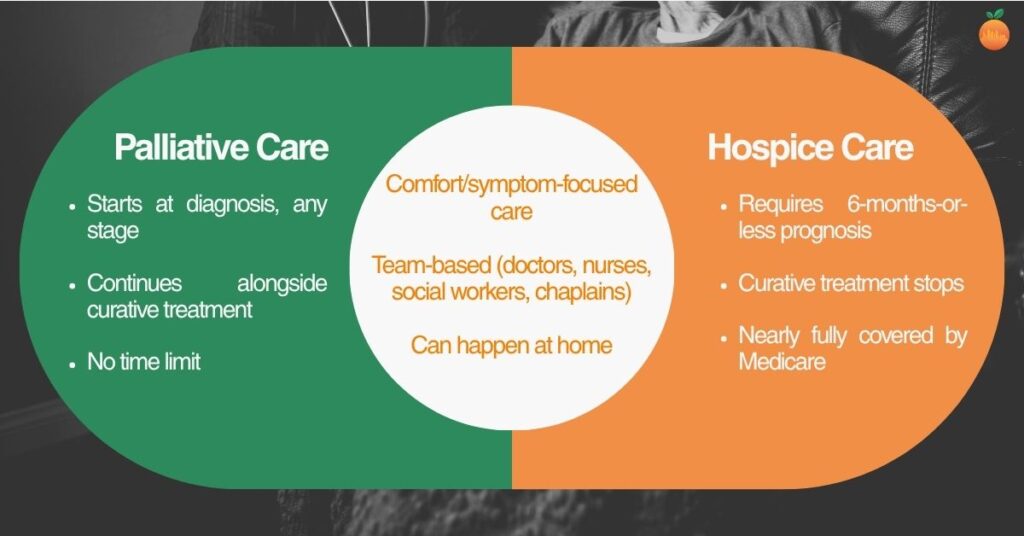
No. Palliative care is comfort-focused medical care for anyone with a serious illness, at any stage, and it can continue alongside treatments meant to cure or control the disease. Hospice is a specific type of palliative care for people with a life expectancy of six months or less who have decided to stop curative treatment.
Put simply, all hospice care is palliative. But not all palliative care is hospice. That one distinction shapes almost everything else, from eligibility to cost.
What Is the Difference Between Palliative Care and Hospice?
The main difference between palliative care and hospice is timing and treatment goals. Palliative care can begin at diagnosis and works alongside chemotherapy, dialysis, or other treatments. Hospice begins when a doctor certifies that life expectancy is six months or less, and the focus shifts entirely to comfort rather than cure. Medicare also pays for each differently.
Think of it as two points on the same road. Palliative care can walk with your loved one for years. Hospice joins near the end of that road, when the goal changes from fighting the illness to living the remaining time as fully as possible.
What Palliative Care Looks Like
Palliative care treats the symptoms and stress of a serious illness. It does not replace your loved one’s regular doctors. Instead, it adds an extra layer of support.
A palliative care team often includes doctors, nurses, social workers, and chaplains. Together, they focus on:
- Pain, shortness of breath, nausea, and fatigue
- Anxiety, depression, and trouble sleeping
- Clear conversations about goals, values, and treatment choices
- Coordination between specialists who may not talk to each other
- Emotional support for the family, not just the patient
People with cancer, heart failure, COPD, kidney disease, Parkinson’s, and dementia can all benefit. There is no time limit. And your loved one does not have to give up any treatment to receive it.
Related Study/Source: A landmark 2010 study in the New England Journal of Medicine followed patients newly diagnosed with advanced lung cancer. Those who received early palliative care alongside standard treatment reported better quality of life and fewer symptoms of depression. They also chose less aggressive end-of-life care, yet lived about 2.7 months longer on average.¹
What Hospice Looks Like
Hospice is for the final stage of a terminal illness. It begins when curative treatment is no longer working, or when the burden of treatment outweighs its benefit.
Most hospice care happens at home. A hospice team visits on a schedule and remains on call around the clock. Care typically includes:
- Nurse visits to manage pain and symptoms
- Medications, medical equipment, and supplies related to the terminal illness
- Help from hospice aides with bathing and personal care
- Social work and spiritual support
- Short-term respite care so family caregivers can rest
- Grief support for the family for up to a year afterward
Hospice does not mean giving up. Many families describe it as the moment care finally became about the person, not the disease. We hear this from our own clients too. Families often tell us hospice is when things finally felt less rushed. For a deeper look at what home hospice involves locally, read our guide to hospice care in Boca Raton.
Palliative Care vs. Hospice at a Glance
Here is a quick side-by-side summary.
Who qualifies
- Palliative care: anyone with a serious illness, at any stage
- Hospice: someone with a life expectancy of six months or less, as certified by a doctor
Curative treatment
- Palliative care: continues as usual
- Hospice: stops for the terminal illness, though care for other conditions can continue
Where it happens
- Palliative care: clinics, hospitals, and sometimes at home
- Hospice: mostly at home, and also in nursing homes and hospice facilities
How long it lasts
- Palliative care: as long as it is needed
- Hospice: in benefit periods that can renew as long as the person remains eligible
Who Pays? Medicare Coverage for Each
Coverage is one of the biggest practical differences. It is also where many families get confused.
Hospice is covered under the Medicare Hospice Benefit, which is part of Medicare Part A. Once enrolled, Medicare pays for nearly everything related to the terminal illness. That includes the hospice team, medications for symptom control, equipment, and supplies. Out-of-pocket costs are usually small. A person may pay a copay of up to $5 per prescription for symptom-control drugs and a small share of inpatient respite care.
Palliative care does not have its own separate benefit. Instead, Medicare Part B usually covers the doctor and nurse practitioner visits involved, much like any specialist visit. Regular deductibles and coinsurance apply. Medicare Advantage plans and private insurance often cover palliative services as well, though details vary by plan.
Always call your plan to confirm what applies to your loved one. A hospital social worker can also help sort out coverage before discharge. Our office fields these coverage questions often, and we’re happy to help a family think through what they’re looking at. And we are more than happy to do this even before any care plan is in place.
Signs It May Be Time to Ask About Hospice
No family wants to have this conversation. But waiting too long often means missing weeks of support that could have made a real difference. Consider asking your loved one’s doctor about hospice if you notice:
- Frequent trips to the emergency room or hospital
- Steady weight loss and little interest in eating
- Sleeping most of the day
- Needing help with most daily activities, like bathing or dressing
- Treatments causing more suffering than benefit
- Your loved one saying they are tired of fighting
Asking is not the same as deciding. A hospice team can meet with your family for an informational visit, with no obligation to enroll.
Can You Switch From One to the Other?
Yes. Many people start with palliative care and move to hospice later as their illness progresses. That path is common and often smooth, since the goals already overlap.
The door also swings the other way. A person can leave hospice at any time. Some choose to resume treatment. Others improve and no longer qualify. If circumstances change again, they can re-enroll later.
How to Talk With Your Loved One About It
These conversations rarely feel natural. Still, they go better when they start early, before a crisis forces a rushed decision.
Begin with questions, not choices. Ask what matters most to your loved one right now. Is it staying at home? Being free of pain? Having time with grandchildren? Their answers point toward the right kind of care far more clearly than any checklist.
Next, bring in the medical team. Ask your loved one’s doctor to explain the illness honestly, including what the coming months may look like. Many families find that palliative care teams are especially skilled at leading these talks.
Finally, give it time. Nobody has to decide everything in one sitting. A second or third conversation is normal. What matters is that your loved one’s wishes guide the plan, not panic or guesswork.
Questions to Ask the Care Team
Bring a notebook to appointments. These questions can help you compare palliative care vs. hospice for your loved one’s situation:
- What is the expected course of this illness over the next six months?
- Would palliative care help with the symptoms we are seeing now?
- Is my loved one eligible for hospice, and if not, what would change that?
- Which treatments are helping, and which may be adding burden?
- What will our insurance cover for each option?
- Who do we call after hours if symptoms get worse?
- How much hands-on care will our family still need to provide?
That last question matters more than most families expect. The answer often shows where extra support at home will be needed. This is usually the point where families realize hospice or palliative team alone won’t cover every hour of every day. That is when a conversation with us tends to start.
Planning Ahead With Advance Directives
Whatever path your family takes, written wishes make every step easier. In Florida, two documents do most of the work.
A living will states what medical treatments your loved one does or does not want near the end of life. Meanwhile, a designation of health care surrogate names the person who can make medical decisions if your loved one cannot speak for themselves.
Both documents give doctors and family a clear roadmap. They also take a heavy burden off relatives who might otherwise have to guess. An elder law attorney or your loved one’s doctor can help you get started.
Common Myths
“Hospice means we are giving up.” Hospice changes the goal, not the level of care. Patients often receive more attention and visits than before.
“Palliative care is only for cancer.” It helps with many serious illnesses, including heart failure, lung disease, and dementia.
“You have to be in a facility.” Both types of care can be provided at home. In fact, most hospice care happens there.
“Once you start hospice, you cannot stop.” Your loved one can leave hospice at any point.
Where Home Care Fits In
Neither hospice nor palliative care provides round-the-clock help at home. Hospice aides visit on a schedule. Palliative teams focus on medical symptoms and planning. That often leaves families covering long stretches of the day and night on their own.
This is where City Choice Home Health Care can help. For more than two decades, our Medicare-certified agency has supported families across Boca Raton, Delray Beach, and Boynton Beach. Our caregivers can add hands-on help between visits. That includes bathing, meals, companionship, and overnight support. We also work alongside your loved one’s medical and hospice teams, so everyone stays on the same page. City Choice built relationships with hospice teams across Palm Beach County specifically, so those handoffs feel seamless to the family, not like two separate systems operating side by side.
What Family Caregivers Often Carry
Families usually picture hospice or palliative care taking over the work. In reality, much of the daily care still falls to them. Someone has to help with meals, medications, bathing, and repositioning. And someone has to be there at 3:00 a.m. when pain flares or confusion sets in.
That load builds quickly. Spouses who are older themselves often feel it first. Adult children juggling jobs and their own kids feel it too. Sleep slips, patience wears thin, and guilt follows close behind.
None of this means your family is failing. It means the job is bigger than one or two people. Recognizing that early protects both your loved one and you. Our guide to caregiver burnout covers the warning signs worth watching. It’s something our own care coordinators watch for too. With the families we work with, we will often flag it before the family says anything out loud.
Care at home is often what makes the final chapter feel like home. You can read more about the benefits of home care for Palm Beach families. Or give us a call, and we will talk through what your family needs right now.
Frequently Asked Questions
Can Someone Receive Palliative Care at Home?
Yes. Many palliative care programs offer home visits, especially for people who have trouble traveling. Availability depends on the provider and your insurance. Ask your loved one’s doctor for a referral to a local program.
Who Decides When Hospice Starts?
The patient or their legal representative makes the choice. However, a doctor must first certify that life expectancy is six months or less if the illness follows its usual course. The hospice medical director also confirms eligibility.
What Happens If My Loved One Lives Longer Than Six Months?
That is fine and not unusual. Hospice is provided in benefit periods. As long as a doctor recertifies that your loved one still qualifies, care continues.
Is Palliative Care the First Step Toward Hospice?
Not necessarily. Some people receive palliative care for years and never need hospice. Others recover from the illness entirely. Palliative care is about comfort during a serious illness, whatever direction that illness takes.
Does Hospice Care Speed Up Death?
No. Hospice neither hastens nor delays death. Its purpose is comfort. Some research even suggests people in hospice or palliative care may live slightly longer, likely because symptoms are better controlled.
The Right Care at the Right Time
Understanding palliative care vs. hospice gives your family options instead of pressure. Palliative care can start early and walk beside treatment. Hospice steps in when comfort becomes the whole goal. Both are about dignity, and neither has to happen without support at home. Our office is a short drive from most of the families we serve in Boca Raton, Delray Beach, and Boynton Beach. So please reach out whenever you’re ready to talk through what’s next.
Related Articles
- Hospice Care in Boca Raton
- Skilled Nursing at Home: What Medicare Will and Won’t Cover
- Levels of Care for Seniors
- Caregiver Burnout: Signs, Symptoms, and How to Prevent It
- What Happens After Hospital Discharge
Sources
- Temel JS, Greer JA, Muzikansky A, et al. Early palliative care for patients with metastatic non-small-cell lung cancer. N Engl J Med. 2010;363(8):733-742. doi:10.1056/NEJMoa1000678
- National Institute on Aging. What are palliative care and hospice care? Accessed September 23, 2026.
- Centers for Medicare & Medicaid Services. Hospice care. Medicare.gov. Accessed September 23, 2026. https://www.medicare.gov/coverage/hospice-care