 Family Caregiver Resources
Congestive heart failure in elderly adults means the heart cannot pump enough blood for the body’s needs. It does not mean the heart has stopped. With daily weight checks, steady medicines, a low-salt routine, and quick calls to the doctor, many seniors manage heart failure at home.
The diagnosis can feel frightening. Your parent may be short of breath, swollen, and tired, and you may feel unsure what to watch for. This guide explains the basics in plain language. It also shows families in Boynton Beach, Delray Beach, and Boca Raton how to support care at home.
What Is Congestive Heart Failure in Elderly Adults?
Congestive heart failure in elderly adults is a condition in which the heart cannot pump enough blood and oxygen to meet the body’s needs, so fluid can build up in the lungs, legs, and belly. It does not mean the heart has stopped. Early diagnosis and treatment can improve both quality and length of life.
The word “congestive” refers to that fluid buildup. Doctors now often say simply “heart failure,” but many families still use both terms. The condition is long-term. Treatment aims to ease symptoms, slow the damage, and keep your parent out of the hospital.
Related Study/Source: The CDC reports that nearly 6.7 million U.S. adults age 20 and older have heart failure. The agency adds that early diagnosis and treatment can improve quality and length of life, and that patients should track symptoms daily to share with their health care team.¹
What Are the Signs of Heart Failure in Seniors?
Common signs of heart failure in seniors include shortness of breath during daily activities, trouble breathing when lying down, swelling in the feet, legs, ankles, or belly with weight gain, and ongoing tiredness or weakness. Confusion can also appear. Family members often notice these changes first, so report anything new to the doctor right away.
Symptoms can creep in slowly. A parent may stop climbing stairs, sleep in a chair, or say their shoes feel tight. Those small shifts matter. The American Heart Association notes that confusion or impaired thinking may be noticed by family members first.²
MedlinePlus suggests asking these questions every day:³
- Is energy lower than yesterday?
- Is there more shortness of breath with everyday tasks?
- Do clothes or shoes feel tight?
- Are the ankles or legs swollen?
- Is there a new or wet-sounding cough?
- Is breathing hard at night?
None of these signs proves heart failure by itself. Many conditions cause swelling or breathlessness. But together they form a pattern. If you notice two or more, schedule a visit and bring your notes.
Why Do Daily Weight Checks Matter?
Weigh your parent every morning on the same scale, after using the bathroom and before eating, in similar clothing. Call the doctor if weight rises more than two to three pounds in one day or more than five pounds in one week. Sudden weight gain is often the first sign that heart failure is worsening.
Fluid is heavy. A quick jump on the scale often means the body is holding extra water, even before swelling shows. The American Heart Association says many people first notice worsening heart failure through weight gain of more than two or three pounds in a day, or more than five pounds in a week.²
Make the routine easy. Keep the scale in the bathroom, and set a notebook beside it. Write down the date, weight, and any symptoms. Share the log at every appointment. Ask the doctor what number counts as a problem for your parent, since targets differ.²
When Should You Call the Doctor or 911?
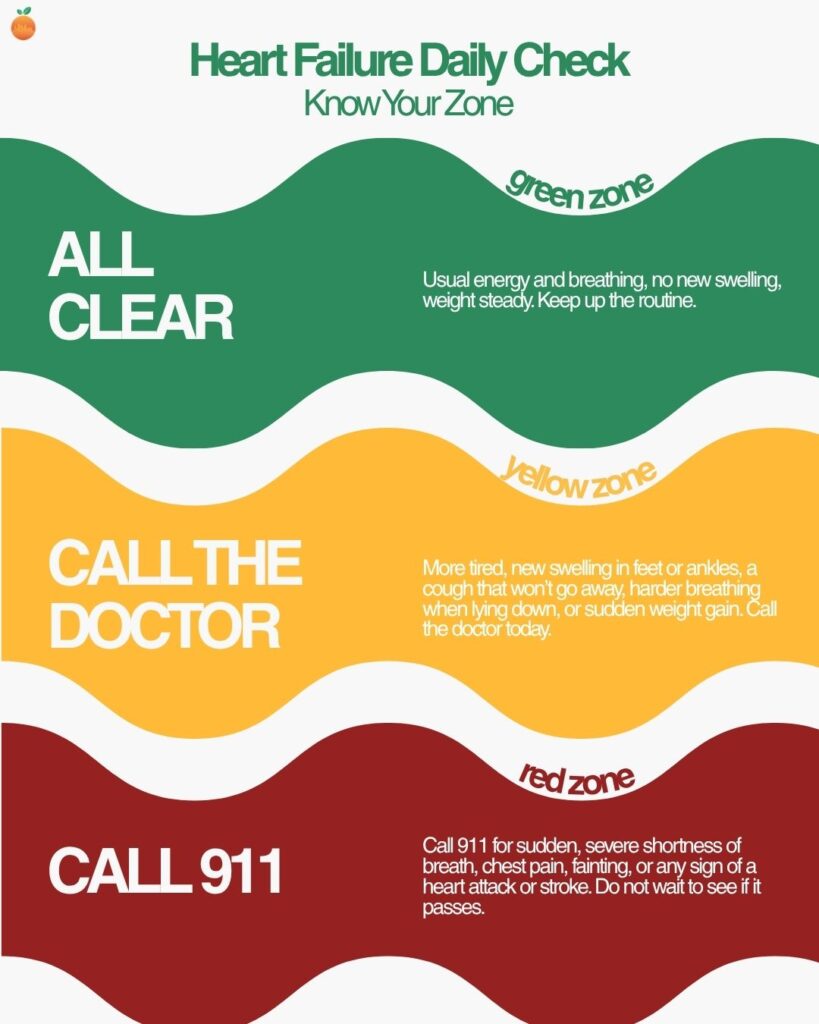
Call the doctor right away if something new appears or a symptom suddenly worsens.² MedlinePlus lists many reasons to call, including:³
- Fatigue or weakness
- Shortness of breath at rest or with activity
- Trouble breathing when lying down, or an hour or two after falling asleep
- A cough that will not go away, or pink, foamy spit
- New swelling in the feet, ankles, or legs
- Frequent urination, especially at night
- Weight gain or a large weight loss
- A pulse that is very slow, very fast, or irregular
Call 911 for sudden, severe shortness of breath, chest pain, fainting, or any sign of a heart attack or stroke. Do not wait to see if it passes. Keep a current medication list and your parent’s doctor’s number on the fridge so help can move fast.
How Do You Care for Someone With Heart Failure at Home?
To care for someone with heart failure at home, weigh them daily, give medicines exactly as prescribed, limit salt and fluids as the doctor directs, and record weights and symptoms in a daily log. Encourage gentle activity and plenty of rest, and call the doctor quickly for new swelling, breathing trouble, or sudden weight gain.
Good management is mostly small habits repeated every day. Your parent’s doctor sets the plan, and the home routine carries it out. The sections below cover each habit.
Medications
Many people with heart failure take several medicines. Some are water pills, called diuretics, that help remove extra fluid and sodium. The American Heart Association notes that clinicians can adjust medications if needed.⁴ Never stop or change a dose without asking. A weekly pill organizer helps, and our guide on medication management for seniors offers practical systems.
Salt and Fluids
The CDC lists cutting back on sodium and limiting fluids among common management steps.¹ Limits vary from person to person. So ask the doctor how much fluid your parent should drink each day.⁴ Read labels, since canned soup, deli meat, and frozen dinners hide a lot of salt.
Activity
Rest matters, but so does movement. The American Heart Association says regular, moderate-intensity physical activity can help the heart get stronger.⁴ A cardiac rehab team can build a plan that fits your parent. Start slowly, and stop if breathing becomes hard.
Sleep and Rest
Extra pillows can make breathing easier at night. The American Heart Association also suggests avoiding naps, big meals, caffeine, and alcohol right before bedtime.⁴ If your parent takes a water pill, ask whether morning is the best time to take it.
Vaccines and Checkups
Ask the care team about a yearly flu vaccine and a one-time pneumococcal vaccine.⁴ Keep every follow-up visit, even when your parent feels well. Those visits catch problems early.
What Should Meals Look Like With a Low-Salt Plan?
Meals can feel like a puzzle at first. Build them around fresh foods, since packaged and restaurant foods carry the most sodium. Use herbs, lemon, garlic, and pepper for flavor instead of salt. Rinse canned beans and vegetables. Ask the doctor about a visit with a dietitian, who can tailor the plan to your parent’s tastes and other conditions.
Why Does Heart Failure Affect So Many Older Adults?
Age alone is not the cause. But years of strain on the heart add up. The CDC lists coronary artery disease, heart attacks, diabetes, high blood pressure, obesity, and heart valve disease as common risk factors.¹ Smoking, a diet high in fat and sodium, little activity, and too much alcohol raise the risk further.¹
Many seniors have two or three of these at once. That is why heart failure care often overlaps with blood pressure, blood sugar, and weight management. One team and one plan work best.
How Do Florida Heat and Fluid Limits Fit Together?
South Florida summers create a tricky balance. Heat makes people sweat and feel thirsty, yet heart failure may call for fluid limits. Do not guess. Ask the doctor what your parent should do on very hot days, and ask before changing any water pill.
Keep the home cool, plan outings for early morning, and watch for dizziness or confusion. Both too little fluid and too much can cause trouble. Our dehydration guide for Boynton Beach families explains the warning signs of low fluids.
What Does Medicare Cover for Heart Failure at Home?
Medicare covers home health care for people who qualify. A doctor or other provider must see the person in person and order care. The person must be homebound, and a Medicare-certified agency must provide it.⁵
Covered services include part-time skilled nursing, such as patient and caregiver education and monitoring of serious or unstable conditions.⁵ Physical and occupational therapy may also be covered. Medicare does not cover 24-hour care, and it does not pay for personal care when that is the only help needed.⁵ Our guide to skilled nursing at home explains the details.
How Can Family Caregivers Stay Strong?
Heart failure care never takes a day off. The weights, pills, meals, and appointments pile up. Share the tasks. Let one person handle pharmacy runs and another handle meals. And remember that tiredness is a signal, not a weakness. Our post on caregiver burnout explains how to spot it early.
After a hospital stay, the first weeks are the riskiest. Plan ahead for the transition. Our guide on what happens after hospital discharge covers what to expect.
How City Choice Home Health Care of Florida Supports Heart Failure Care
For more than two decades, City Choice Home Health Care of Florida has supported families in Boynton Beach, Delray Beach, and Boca Raton. As a Medicare-certified agency, we have cared for more than 1,000 families.
Our team provides skilled nursing and therapy services at home. Caregivers can help with meals that follow the doctor’s plan, medication reminders, bathing, light housekeeping, and rides to appointments. We also offer overnight or 24-hour care when needed.
Every family’s situation is different. Call us to talk through your options, and we will explain how home health care can fit your parent’s needs. For families facing a more serious stage, our guide to palliative care vs. hospice explains added comfort-focused options.
Frequently Asked Questions
Can Congestive Heart Failure Be Managed at Home?
Yes, for many people. The CDC says common approaches include medicines, less sodium, limited fluids, daily activity, and daily symptom tracking shared with the health care team.¹ Home care supports those habits, but your parent’s doctor guides the plan.
Is Heart Failure the Same as a Heart Attack?
No. A heart attack is a sudden event. Heart failure is a long-term condition in which the heart cannot keep up with the body’s needs. A prior heart attack is one of its risk factors, according to the CDC.¹
Can Heart Failure Cause Confusion?
It can. The American Heart Association lists confusion or impaired thinking among symptoms to track, and family members may see it first.² Sudden confusion always deserves a call to the doctor.
How Much Fluid Should My Parent Drink?
There is no single answer. The American Heart Association advises asking your healthcare professional how much fluid to drink each day.⁴ Write down the number and keep it where everyone can see it.
Small Daily Habits Protect the Heart
Congestive heart failure in elderly adults is serious, but it is also manageable for many families. Weigh daily, take medicines on time, watch for change, and call early. With steady habits and the right support, your parent can spend more days at home and fewer in the hospital.
Related Articles
Dehydration in Elderly Adults: A Florida Heat Guide for Boynton Beach Families
Medication Management for Seniors: A Practical Guide for Delray Beach Families
Skilled Nursing at Home: What Medicare Will and Won’t Cover
What Happens After Hospital Discharge: Why Home Care Is the Next Step
Palliative Care vs. Hospice: What Boca Raton Families Should Know
Sources
1. Centers for Disease Control and Prevention. About heart failure. Accessed October 14, 2026. https://www.cdc.gov/heart-disease/about/heart-failure.html
2. American Heart Association. Managing heart failure symptoms. Accessed October 14, 2026. https://www.heart.org/en/health-topics/heart-failure/warning-signs-of-heart-failure/managing-heart-failure-symptoms
3. MedlinePlus. Heart failure: home monitoring. National Library of Medicine. Accessed October 14, 2026. https://medlineplus.gov/ency/patientinstructions/000113.htm
4. American Heart Association. Lifestyle changes for heart failure. Accessed October 14, 2026. https://www.heart.org/en/health-topics/heart-failure/treatment-options-for-heart-failure/lifestyle-changes-for-heart-failure
5. Centers for Medicare & Medicaid Services. Home health services. Medicare.gov. Accessed October 14, 2026. https://www.medicare.gov/coverage/home-health-services