 Home Care Guides
When a veteran passes away, the surviving spouse often faces two losses at once. There is the grief, of course. And then there is the practical worry about how to manage on one income, especially as their own health needs grow.
Many surviving spouses have no idea they may qualify for benefits based on their late husband’s or wife’s military service. One of the most overlooked is the VA Survivors Pension, paid by the Department of Veterans Affairs (VA). Combined with Aid and Attendance, it can help pay for care at home. This guide explains who qualifies, how the benefit works, and how families in Boca Raton, Delray Beach, and Boynton Beach can get care started without waiting months for approval.
What Is the VA Survivors Pension?
The VA Survivors Pension is a tax-free monthly payment from the Department of Veterans Affairs for low-income surviving spouses and unmarried children of wartime veterans. Importantly, the veteran’s death need not be related to military service. Eligibility depends on the veteran’s service dates, the survivor’s marital status, and household income and net worth limits set by Congress.
Some people call it the “widow’s pension” or “death pension.” The official name is Survivors Pension. It is a needs-based benefit, which means it is designed for survivors with limited financial resources.
The VA adjusts the payment limits each year. So it is important to check current figures on VA.gov or with an accredited representative before applying.
What VA Benefits Are Available for a Surviving Spouse?
VA benefits for a surviving spouse can include the Survivors Pension, Dependency and Indemnity Compensation for service-connected deaths, Aid and Attendance or Housebound payments for those needing care, health coverage through CHAMPVA in some cases, education benefits, home loan guarantees, and burial benefits. Which ones apply depends on the veteran’s service, cause of death, and the survivor’s needs.
For families focused on paying for care at home, the Survivors Pension and Aid and Attendance are usually the most relevant. The rest of this guide focuses on those two.
Who Qualifies for the VA Survivors Pension?
Eligibility has three main parts. All three need to line up.
The Veteran’s Service
The deceased veteran must have served during a recognized wartime period and received a discharge that was not dishonorable. According to the VA, the service must meet one of these requirements:
- Entered active duty on or before September 7, 1980, and served at least 90 days, with at least one day during wartime
- Began active duty after September 7, 1980, and served at least 24 months or the full period ordered, with at least one day during wartime
- Served as an officer who began active duty after October 16, 1981, and had not previously served 24 months
The veteran did not need to serve in combat. Stateside service during a wartime period counts.
Recognized Wartime Periods
The VA recognizes several wartime periods for pension purposes. These include World War II, the Korean Conflict, the Vietnam War era, and the Gulf War era, which began on August 2, 1990, and has not officially ended. Earlier periods are also listed on VA.gov.
The Surviving Spouse
The survivor generally must not have remarried after the veteran’s death. Other marriage requirements may apply, such as how long the couple was married. The VA’s application explains these rules in detail.
Income and Net Worth
This is where many families assume they will not qualify. But there is an important detail that often changes the math.
How Home Care Costs Can Help You Qualify
The VA does not simply look at gross income. It subtracts certain unreimbursed medical expenses from countable income. Those expenses can include the cost of in-home care when a person needs help because of a health condition.
That means a surviving spouse with modest income who is paying for a caregiver may qualify for the VA Survivors Pension, even if their income alone seems too high. As care costs rise, countable income drops.
Related Study/Source: VA regulations allow certain unreimbursed medical expenses to be deducted from a claimant’s income when determining pension eligibility. For people who need help with daily activities, these can include payments to in-home attendants and home care providers.¹
The VA also reviews net worth, which includes assets like savings and investments. A primary home is generally excluded. In addition, the VA looks back three years at asset transfers. Moving money to relatives to qualify can trigger a penalty period. An accredited representative can help you understand the rules before making any changes.
Adding Aid and Attendance for Surviving Spouses
Aid and Attendance is an extra monthly amount added on top of the VA Survivors Pension. It is meant for survivors who need regular help from another person.
A surviving spouse may qualify if they:
- Need help with daily activities like bathing, dressing, eating, or using the bathroom
- Are mostly confined to bed because of illness
- Live in a nursing home because of a mental or physical disability
- Have very limited eyesight, as defined by VA standards
A related benefit, called Housebound, is available for survivors who are mostly confined to their home because of a permanent disability. Survivors cannot receive both at the same time.
Our guide to VA Aid and Attendance covers the benefit in depth, including how it works for veterans themselves.
Survivors Pension vs. DIC
Families sometimes confuse the Survivors Pension with Dependency and Indemnity Compensation, known as DIC. They are different programs.
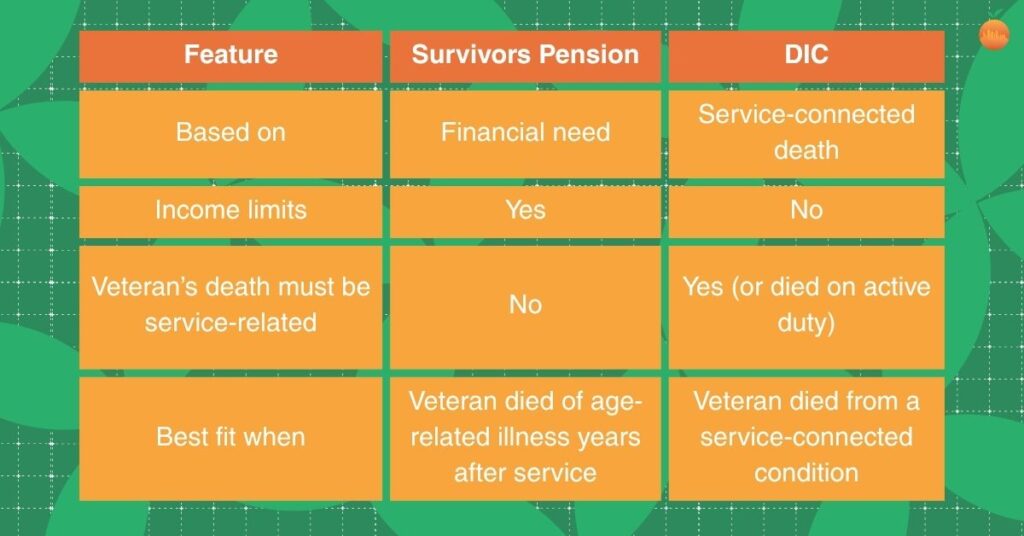
The VA Survivors Pension is needs-based. Here, the veteran’s death does not need to be connected to service, but income and net worth limits apply. It is often the better fit when the veteran died of age-related illness decades after leaving the military.
DIC is for survivors of veterans who died from a service-connected condition or while on active duty. It is not based on income.
A survivor cannot receive both at once. If eligible for both, the VA pays whichever benefit is greater. The same application form covers both, so families do not need to decide in advance.
How to Apply
Applying takes some organization, but it is manageable with the right documents. Here is a general roadmap:
- Gather the veteran’s discharge papers. The DD214 or other separation documents prove service dates and character of discharge.
- Collect the marriage and death certificates. These show the relationship and the date of death.
- List income and assets. Include Social Security, pensions, bank accounts, and investments.
- Document medical expenses. Keep records of insurance premiums, prescriptions, and in-home care costs.
- Complete VA Form 21P-534EZ. This is the Application for DIC, Survivors Pension, and/or Accrued Benefits.
- Add medical evidence for Aid and Attendance. A doctor typically completes VA Form 21-2680 describing the need for help.
- Submit and follow up. Keep copies of everything you send.
Accredited Veterans Service Officers can help with applications at no cost. Be cautious of anyone who charges a fee just to help you apply.
Common Mistakes to Avoid
A few missteps can delay or derail a claim. Watch for these as you prepare the application.
Assuming income is too high. Many families never apply because income looks too high on paper. But unreimbursed medical and care costs can lower countable income significantly.
Missing discharge papers. Without proof of service, the claim stalls. If the DD214 is lost, you can request a copy from the National Archives.
Moving assets before applying. Gifting money or property within the three-year look-back period can lead to a penalty. Get advice first.
Leaving out care expenses. Every eligible medical cost you document can matter. Keep receipts, invoices, and insurance statements organized.
Paying for application help. Accredited Veterans Service Officers help for free. Be wary of anyone who charges to file a claim or promises guaranteed approval.
Talking With a Surviving Parent About Benefits
For adult children, raising this subject can feel delicate. A widowed parent may see it as charity, or may not want to talk about money at all.
Start by framing the benefit as something earned. The Survivors Pension exists because of the veteran’s service. Accepting it honors that service rather than taking a handout. Many surviving spouses feel differently once they see it that way.
Keep the focus on what the benefit makes possible. Help with bathing, a caregiver who stops by each morning, or someone to drive to appointments can protect independence. Offer to handle the paperwork together, so your parent does not feel alone with it.
The Waiting Problem, and How VetAssist Helps
Here is the hard part. VA Survivors Pension claims can take months to process, and adding Aid and Attendance means gathering even more medical evidence. Every week of waiting matters when someone needs help today. Meanwhile, a surviving spouse who needs help at home cannot wait that long. Many families end up delaying care, draining savings, or stretching family caregivers to the breaking point.
This is exactly where the VetAssist Program comes in.
City Choice Home Health Care partners with Veterans Home Care and its VetAssist Program. VetAssist serves both veterans and surviving spouses. Since 2003, it has helped more than 23,000 veterans and surviving spouses access VA benefits for home care.
Here is how the partnership works for families:
- Help with the application. The VetAssist team assists with assembling and filing the VA paperwork.
- A 0% interest loan. VetAssist advances the cost of care with an interest-free loan, so care can begin while the VA reviews the application.
- Care from City Choice. Our caregivers begin providing support at home right away.
- Benefits take over. Once the VA approves the claim, the monthly benefit helps cover the cost of ongoing care.
For a surviving spouse, this can mean the difference between waiting months alone and getting help this week.
How City Choice Supports Surviving Spouses
City Choice has served families across Boca Raton, Delray Beach, and Boynton Beach for more than two decades. Our Medicare-certified agency has cared for more than 1,000 families, including many veterans and their spouses.
Day to day, our caregivers can provide:
- Help with bathing, dressing, and personal care
- Meal preparation and light housekeeping
- Medication reminders
- Companionship and emotional support after loss
- Transportation to appointments
- Overnight or 24-hour care when needed
Grief can make daily life harder in ways families do not always see. A steady, caring presence at home helps surviving spouses stay safe, connected, and independent. To learn more about our veteran-focused services, read our guide to in-home care for veterans.
Frequently Asked Questions
Can a Surviving Spouse Get Aid and Attendance?
Yes. A surviving spouse who qualifies for the Survivors Pension can receive Aid and Attendance if they need help with daily activities, are bedridden, live in a nursing home due to disability, or have very limited eyesight.
Does the Veteran Need to Have Served in Combat?
No. The veteran needs at least one day of active service during a recognized wartime period, but it does not need to be combat service or overseas.
What If the Surviving Spouse Remarried?
Generally, a survivor who remarried after the veteran’s death is not eligible for the Survivors Pension. Some exceptions exist, so check with an accredited representative.
How Long Does the Application Take?
Processing times vary and can take several months. That is why programs like VetAssist, which help care begin before approval, are so valuable.
Honoring Service by Caring for Those Left Behind
The VA Survivors Pension exists because a veteran’s service matters to the family they leave behind. For many surviving spouses, it can be the key to staying safely at home. And with VetAssist and City Choice working together, care does not have to wait for the paperwork.
Related Articles
- VA Aid and Attendance: How Veterans in Palm Beach County Can Pay for In-Home Care
- In-Home Care for Veterans in Boca Raton, Delray Beach, and Boynton Beach
- Does the VA Pay for Home Health Aides?
- Veteran-Directed Care vs. VA Homemaker Aide
- Respite Care for Veteran Caregivers
Sources
- Deductible medical expenses. 38 CFR §3.278. Accessed September 23, 2026. https://www.ecfr.gov/current/title-38/chapter-I/part-3/subpart-A/subject-group-ECFR6d0bdbe96f31fdf/section-3.278
- U.S. Department of Veterans Affairs. Survivors Pension. Accessed September 23, 2026. https://www.va.gov/pension/survivors-pension/
- U.S. Department of Veterans Affairs. VA Aid and Attendance benefits and Housebound allowance. Accessed September 23, 2026. https://www.va.gov/pension/aid-attendance-housebound/
- Veterans Home Care. The VetAssist Program. Accessed September 23, 2026. https://www.veteranshomecare.com/