 Family Caregiver Resources
Does the VA Pay for Home Health Aides?
Yes, in several ways. The VA doesn’t pay a home health aide’s bill directly, like a typical insurance claim. It funds aide services through specific programs, or provides cash benefits toward aide costs. Does the VA pay for home health aides automatically? No, it depends on service history, health needs, and which program applies.
That distinction confuses a lot of families at first. There isn’t one single “VA home health aide benefit.” There are several, and they work differently from each other. This guide walks through the main ones, so you know which questions to ask next.
How VA Home Health Aide Coverage Works
VA coverage for home health aides isn’t structured like typical health insurance. Some programs send an aide directly, through an agency under VA contract. Others give the veteran money and let them arrange care independently. A few require documented medical need. Others are based more broadly on daily living challenges.
This matters because the right program depends heavily on individual circumstances. A veteran with a service-connected disability may have more options available. One who is already enrolled in VA health care starts from a different point than one who isn’t enrolled yet.
Ways the VA Can Help Pay for Home Health Aides
The Homemaker and Home Health Aide Program
This program is part of the VA’s standard medical benefits package. It connects eligible veterans with a trained aide through a VA-contracted agency. A registered nurse supervises the care. Any enrolled veteran who meets the clinical need for daily assistance can qualify, regardless of age or disability rating.
VA Aid and Attendance
Aid and Attendance is a monthly pension add-on, not a direct service. It pays the veteran or surviving spouse cash. That cash can go toward a home health aide of the family’s choosing. Eligibility depends on service history, care needs, and financial limits, not a specific disability rating.
Veteran-Directed Care
This program gives eligible veterans a flexible budget for home and community-based care. Veterans can use that budget to hire an aide, including in many cases a family member. It offers more control than the agency-based program, though it also requires more hands-on management from the veteran or their representative.
Community Care Network
Through the Community Care Network, the VA authorizes approved community providers to deliver home health aide and homemaker services. The VA pays the provider directly for approved care. This network overlaps with the Homemaker and Home Health Aide program in practice. Many agencies deliver that program specifically through Community Care Network contracts.
Who Qualifies for VA-Funded Home Health Aide Support
Qualification depends on which program a family pursues. Broadly, though, most paths require two things. First, enrollment in VA health care. Second, a documented need for help with daily activities like bathing, dressing, or medication management.
A service-connected disability isn’t required for most of these programs. That surprises many families. They often assume VA home care benefits only apply to combat-related injuries. In reality, aging alone, without any combat history, is often enough to qualify for meaningful support.
What These Programs Typically Don’t Cover
VA home health aide benefits generally focus on personal care and daily living support, not skilled nursing or medical treatment. Wound care, IV therapy, and other clinical services usually fall under separate VA home health care benefits. Those are delivered by nurses, not aides.
Long-term nursing home stays are also handled through separate VA programs entirely. Most home health aide benefits also have limits on weekly hours. Families with very high care needs may need to combine VA support with private-pay care to fill any gaps.
How to Find Out What a Veteran Qualifies For
The fastest path is a conversation with a VA social worker or case manager. This can happen through a local VA medical center or the VA’s caregiver support line. They can walk through a veteran’s specific service history and health status. From there, they can identify which programs actually apply.
Accredited Veterans Service Organizations can also help, often at no cost. They’re especially useful for paperwork-heavy programs like Aid and Attendance, where documentation errors are the most common cause of delay.
City Choice also partners directly with the VetAssist Program at Veterans Home Care, which specializes in the Aid and Attendance application. Their team handles the paperwork and can advance the cost of a home health aide through a 0% interest loan while the application is under VA review.
What Happens Once a Veteran Is Approved
Approval looks different depending on the program. Under the Homemaker and Home Health Aide program, the VA connects the veteran with a contracted agency, and care usually starts with an in-home assessment. Aid and Attendance works differently: monthly payments begin, and the family decides how to use them, whether that’s hiring an aide, paying a home care agency, or covering related expenses.
Veteran-Directed Care adds one more step. A counselor helps the veteran build a spending plan before care begins. This step takes a bit more time upfront, but it gives the veteran more say in exactly how the budget gets used. The Community Care Network works differently still: the VA authorizes a specific provider, and that provider bills the VA directly for approved services.
In every case, ongoing documentation matters. The VA periodically reviews continued eligibility, especially for needs-based benefits like Aid and Attendance. Keeping care logs, invoices, and updated medical statements organized from the start makes those reviews far less stressful.
A Quick Comparison of the Main Options
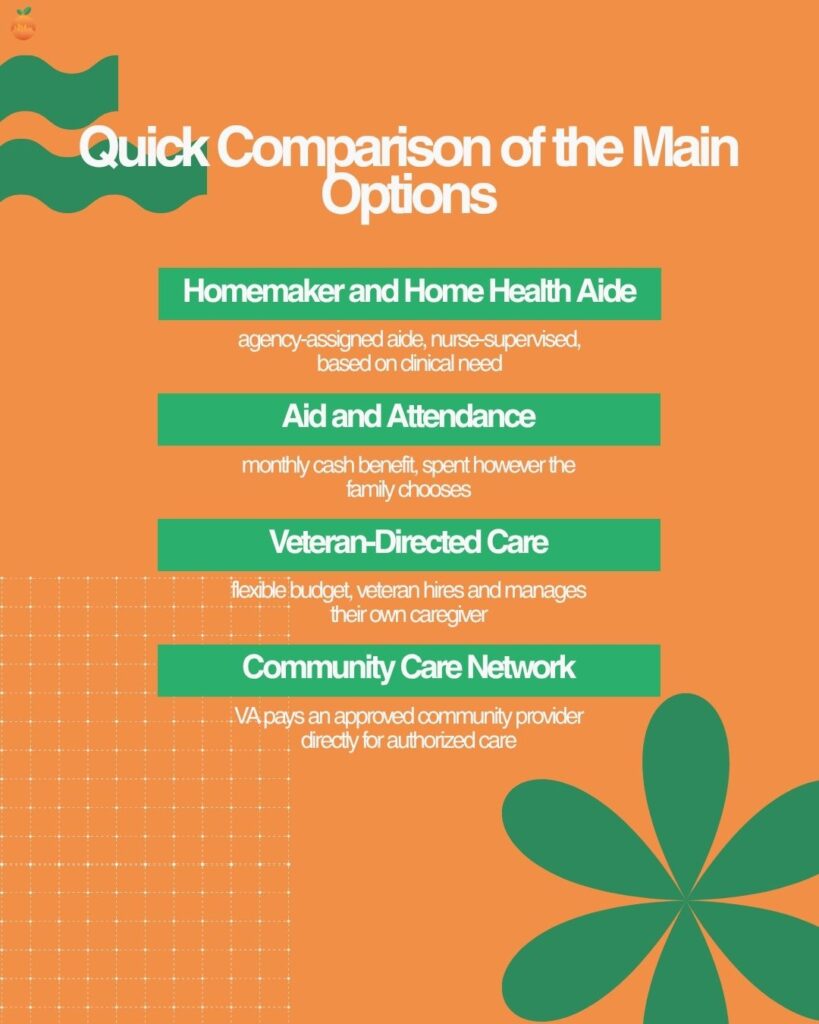
- Homemaker and Home Health Aide: agency-assigned aide, nurse-supervised, based on clinical need
- Aid and Attendance: monthly cash benefit, spent however the family chooses
- Veteran-Directed Care: flexible budget, veteran hires and manages their own caregiver
- Community Care Network: VA pays an approved community provider directly for authorized care
Many families end up using more than one of these together, since they solve different parts of the same problem: funding, staffing, and flexibility.
Common Questions From Families
Is home health aide care free for veterans?
Not always, but it’s often significantly reduced. Some programs involve a copay tied to service-connected disability status. Others, like Aid and Attendance, pay the veteran directly rather than covering a bill. Out-of-pocket cost depends on how the family uses the funds.
Can a veteran get more than one of these benefits at once?
Yes, in many cases. Aid and Attendance is commonly combined with the Homemaker and Home Health Aide program or Veteran-Directed Care, since it provides cash support while the other programs provide the actual caregiving arrangement.
What if the VA denies a request for home health aide support?
A denial isn’t necessarily final. Many denials stem from incomplete documentation, not a genuine lack of eligibility. Appealing, or reapplying with stronger medical evidence, resolves many of these situations. A Veterans Service Organization can help identify what went wrong the first time.
Does the VA pay for home health aides for surviving spouses?
Sometimes, yes. Surviving spouses of qualifying veterans may be eligible for Aid and Attendance, which can help fund a home health aide. Some other programs are limited to veterans themselves, so it’s worth checking eligibility for each specific benefit.
In-Home Care Support in Boca Raton, Delray Beach, and Boynton Beach
City Choice Home Health Care has worked with veterans and families across Palm Beach County for more than two decades. That includes over 1,000 families in Boca Raton, Delray Beach, and Boynton Beach. We regularly help families sort through exactly this question: which VA program, or combination of programs, fits their situation.
Some families come to us with VA benefits already sorted out, ready to build a care plan around them. Others are still trying to figure out where to start. Either way, we can talk through what a home health aide’s role would actually look like day to day. We can also explain how it fits alongside whatever VA support a veteran receives.
If you’re not sure which VA path applies to your family, reach out. We’re happy to talk through the options, without pressure or a sales pitch attached.