 Senior Health Wellness
If Your Mother Is in Denial About Dementia, Here’s What Actually Works
If your mother is in denial about dementia, the fastest way forward isn’t a bigger argument. It’s a smaller one. Stop trying to convince her she has dementia. Start focusing on specific, observable problems instead — missed medications, a stove left on, the same story told three times in one visit. Get her in front of a doctor for those problems, not for a “dementia test.”
Denial rarely breaks from confrontation. It softens when the conversation stops being about a diagnosis and starts being about her safety today.
That’s the short version. If you’re a caregiver in Boca Raton, Delray Beach, or Boynton Beach reading this at 11 p.m. because your mother just insisted, again, that she’s “fine,” here’s the longer version. What denial actually is. Why it happens. What it puts at risk. And what to do about it, starting this week.
Related: When Home Isn’t Enough Alone: Signs It’s Time for Home Care in Florida
Signs Your Mother Is in Denial About Dementia (Or Is It Anosognosia?)
Before you can respond to what’s happening, it helps to know which of two very different things you’re dealing with.
Denial is psychological. Your mother knows, on some level, that something is off, and she’s choosing not to look at it directly. It’s a defense mechanism, the same one that shows up after any frightening diagnosis. She may be protecting her independence, her role in the family, or simply avoiding the fear of what comes next.
Anosognosia is neurological. It’s the term for a specific effect dementia has on the brain, where the disease damages the areas responsible for self-awareness. A person with anosognosia isn’t being stubborn or avoidant. She genuinely cannot perceive that her memory or judgment has changed. Researchers estimate that a majority of people with Alzheimer’s disease show some degree of this lack of insight, and it tends to increase as the disease progresses.
Why does the distinction matter? Because your strategy depends on it. Denial can sometimes be worked through with patience, trust, and time. Anosognosia can’t be reasoned away, no matter how much evidence you present. It isn’t a debate you can win, because your mother isn’t withholding the truth from you — her brain isn’t giving it to her.
Once you accept that, a lot of the frustration starts to make sense. “But I showed her the burnt pot on the stove and she still says she’s fine” stops feeling personal. This is the real test for whether your mother is in denial about dementia or dealing with anosognosia instead.
Most families are dealing with some mix of both. That’s normal. You don’t need a clinical diagnosis to start acting. You need a doctor’s visit, which brings us to the next question.
Additional reading: Home Care vs. Home Health Care
Why Won’t My Mother Admit Something Is Wrong?
If you strip away the frustration, most denial about dementia comes down to a short list of very human fears.
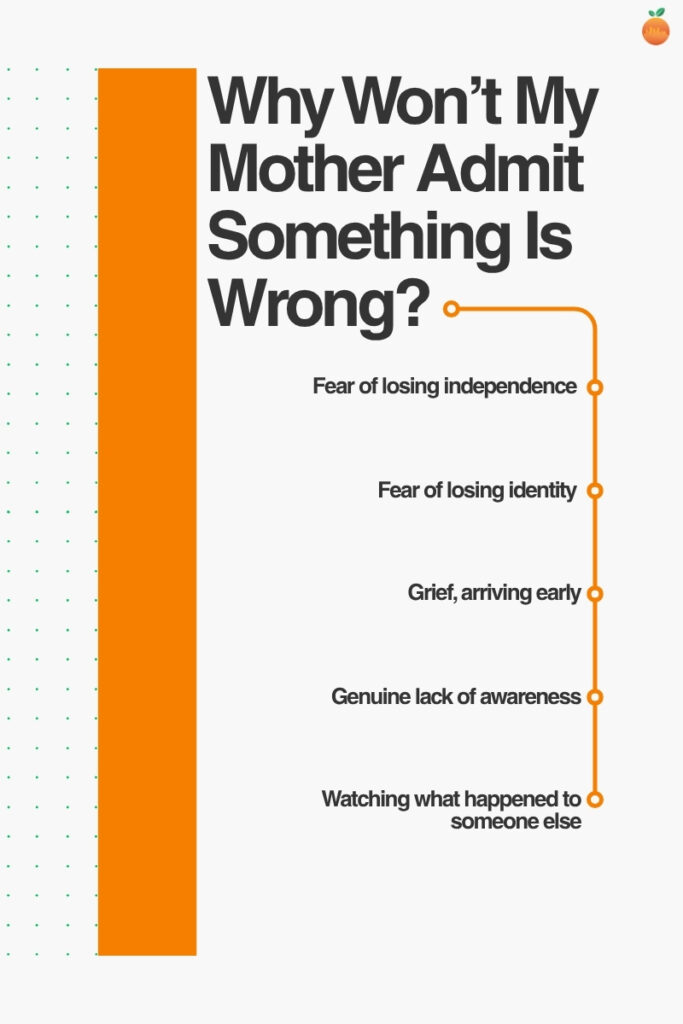
Fear of losing independence. Admitting to memory problems, in her mind, might mean losing her car keys, her house, or her say in her own life — sometimes all at once, sometimes tomorrow.
Fear of losing identity. Think of a woman who has spent decades remembering birthdays and keeping everyone else organized. A dementia diagnosis can feel like an erasure of who she is.
Grief, arriving early. Some denial is really pre-grief, an unconscious way of postponing a loss that hasn’t fully happened yet.
Genuine lack of awareness, as covered above.
Watching what happened to someone else. If your mother cared for her own mother or a spouse through dementia, she may know exactly what it can look like in its later stages. She may be terrified of that future.
None of these are irrational. They’re protective. A mother is in denial about dementia for reasons that make sense to her, even if they don’t help her safety. Recognizing that makes it easier to respond with patience instead of a lecture.
Signs She’s Declining, Even If She Won’t Admit It
Denial doesn’t make the underlying changes disappear. It just means your mother won’t be the one to report them. That puts more weight on what you observe directly.
Common signs worth tracking, even in someone who insists she’s fine:
- Repeating the same question or story within a single conversation
- Missing or doubling up on medications
- Getting lost on a familiar drive, or hesitating at turns she’s made for twenty years
- Leaving the stove, oven, or a faucet running
- Withdrawing from friends, church, or activities she used to enjoy
- Struggling to follow a recipe, balance a checkbook, or complete a once-automatic task
- Sudden irritability or defensiveness when a mistake is pointed out
One or two of these, occasionally, can be normal aging. A pattern that’s progressing over months is worth a medical opinion — not a family diagnosis delivered at Sunday dinner. This is often the clearest sign that a mother is in denial about dementia rather than simply having an off week.
How Do I Talk to Her Without Starting a Fight?
The right approach shifts depending on how far along things are. But one principle stays the same: correct the situation, not the person.
If she’s still mostly independent. Skip direct confrontation about memory. Ask open questions instead of testing her. Try “What do you remember about today?” instead of “Do you remember what I told you an hour ago?” Suggest a routine doctor visit instead. Frame it around something else entirely, like a physical or a medication review. Praise what she’s still doing well. Small wins build trust for the harder conversations later.
If things have progressed further. Break requests into smaller steps. Offer choices instead of open-ended decisions. Try “Do you want the blue sweater or the gray one” rather than “What do you want to wear.” Use visual cues around the house — labeled drawers, a large calendar, notes by the door. Avoid correcting every factual error. Pick your battles around safety, not accuracy.
If she’s in a later stage and resistance looks more like agitation or confusion, communication shifts almost entirely away from facts and toward feelings. A calm tone, a gentle hand on the shoulder, and short simple sentences do more than any explanation. At this stage, reassurance matters more than being right.
Whatever the stage, one rule holds. Arguing about whether dementia exists is a fight you cannot win. Every round of it costs you both trust you’ll need later — and it rarely changes anything when a mother is in denial about dementia this deeply.
Must read: What Is Elderspeak? Why It Hurts More Than It Helps
What Happens If We Just Don’t Deal With It?
It’s tempting to let denial run its course, especially if your mother is still functioning day to day. But unaddressed dementia doesn’t stay static. For families in Boca Raton and the surrounding area, a few risks show up more often than others.
Driving. Florida’s roads and an unacknowledged decline in reaction time or judgment are a dangerous combination, both for your mother and for anyone else on the road.
Medication mismanagement. Missed doses, doubled doses, or expired prescriptions are one of the most common ways an unmanaged diagnosis turns into an emergency room visit.
Financial vulnerability. Seniors with unrecognized cognitive decline are frequent targets for scams. They’re also more likely to fall behind on bills or make risky decisions without anyone noticing until the damage is done.
Falls and home safety. A stove left on, a rug that’s suddenly a tripping hazard, wandering after dark — these risks climb the longer changes go unaddressed.
Legal exposure. Once a doctor determines someone is no longer competent to make decisions, she can no longer legally execute documents like a power of attorney or advance directive. Waiting too long to have these conversations can mean losing the chance to have them at all.
None of this is meant to scare you into an ultimatum. It’s meant to shift the timeline. The earlier you get an honest assessment, even a gentle one, the more choices your mother keeps for herself. Acting early is also the best way to help when a mother is in denial about dementia, without taking away her sense of control.
When Is It Time to Bring in Outside Help?
There’s no single moment that makes this decision for you. But a few signals tend to show up together. Missed medications become routine rather than occasional. A fall or near-fall happens. Isolation grows, or a caregiver shows clear signs of burnout. When you start seeing two or three of these at once, it’s usually time to bring in support rather than wait for a crisis to force the decision.
For many families in Boca Raton, Delray Beach, and Boynton Beach, that support looks like in-home care rather than a move out of the house entirely. This is often the easier conversation when a mother is in denial about dementia, since it doesn’t require her to accept a diagnosis — only to accept a little help.
A home health aide who assists with medication reminders, safety checks, and companionship can ease the daily risks above without forcing the bigger conversation before she’s ready. City Choice Home Health Care of Florida works with families across these communities in that in-between stage. It’s the window before a crisis, while there’s still room to plan rather than react. A Medicare-certified home health visit can also be the “doctor visit” that opens the door to an honest conversation about memory, framed around care rather than confrontation.
Frequently Asked Questions
How can I tell if my mother is really in denial, or if she truly doesn’t know? Watch how she responds when confronted with direct evidence, like a missed bill or a burnt pot. If she gets defensive but the fact seems to register somewhere, even briefly, that leans toward denial. If she genuinely seems unable to process that anything happened, that leans toward anosognosia. Either way, the practical response is largely the same: focus on safety, not persuasion.
Should I tell my mother she has dementia if a doctor confirms it? There’s no universal answer, but many geriatric specialists recommend it, gently and gradually. It can open the door to legal and financial planning while she’s still able to participate. A doctor or care team can help you find the right pace and words for your situation.
What if my mother refuses to see a doctor at all? Try reframing the visit around something she’ll accept, like a physical or a blood pressure follow-up, rather than a memory evaluation. Many primary care doctors already screen for cognitive changes during routine visits.
Is it normal for more than one parent to be affected? It happens more often than families expect, especially with aging spouses who’ve spent decades together. Document what you’re observing in each parent separately. Don’t assume one is only “covering” for the other without checking both.
Can I handle all of this on my own? You can try, but you don’t have to, and burnout is a real risk for caregivers managing this alone. Respite care, support groups, and in-home help all exist to prevent the caregiver from becoming the second person in the household who needs care.
A Final Word for Boca Raton Families
When a mother is in denial about dementia, she isn’t rejecting you. She’s protecting something that feels like it’s already slipping away. The way forward isn’t a bigger confrontation. It’s smaller, steadier steps. Track what you see. Get her in front of a doctor for reasons she’ll accept. Bring in support before a crisis makes the decision for you.
If you’re navigating this in Boca Raton, Delray Beach, or Boynton Beach, you don’t have to start alone. City Choice Home Health Care of Florida can help you find that starting point — a Medicare-certified visit that opens the door to care without forcing a conversation your mother isn’t ready to have yet.