 Senior Health Wellness
It starts with a small thing. A missed step on the porch. A forgotten stove. A phone call that goes unanswered a little too long. And suddenly, a family that has never had to ask hard questions finds itself asking the hardest one of all: what do we do now? For many families, this is the moment they first consider home care as an option.
For many Florida families, this is the moment home care enters the conversation. Not as a last resort — but as a lifeline. A way to say: we want you home, safe, cared for, and still yourself.
If your family is somewhere in that moment right now, this guide is for you.
The conversation no one plans to have
Maria noticed it first. Her father, Eduardo, had always been the steadiest person she knew. Retired, proud, still tending his garden in Tampa every Sunday morning. But over the past year, things had quietly shifted. The garden looked different. He was moving more carefully. He’d lost weight he hadn’t meant to lose.
This is how it goes for most families. The need doesn’t arrive with a announcement. It accumulates, quietly, in small moments — until one day the weight of it becomes impossible to ignore.
When she brought it up at a family dinner, her brother Carlos pushed back. “He’s fine,” he said. “He just needs more rest.” Her mother, Sofia, didn’t say anything. She had noticed too. She just didn’t know where to begin.
“Home is a place of emotional and physical associations, memories and comfort.”
— World Health Organization, as cited in Genet et al., BMC Health Services Research, 2011
What Maria’s family needed wasn’t a nursing home. They didn’t need to uproot Eduardo from the home he’d lived in for 34 years. What they needed was support — professional, reliable, compassionate support — delivered right where he was.
That’s exactly what professional home care services in Florida are designed to provide.
So what is home care, really?
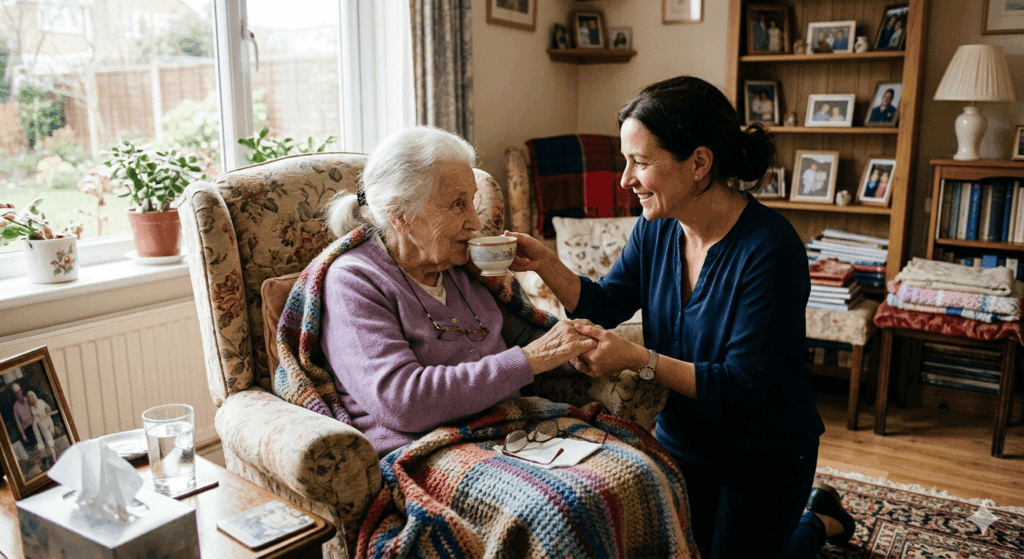
Home care is professional support delivered to a person’s home. It isn’t a single service — it’s a spectrum that bends to fit whoever needs it. A licensed nurse checking in three times a week. A caregiver helping with a morning routine. A companion sitting down for coffee and conversation on a Tuesday afternoon.
The services that fall under home care in Florida include:
- Skilled nursing care: Wound care, medication management, injections, post-surgical monitoring — delivered by licensed professionals at home.
- Physical and occupational therapy: Rebuilding strength, mobility, and daily function after surgery, injury, or illness — without leaving home.
- Personal care assistance: Help with bathing, dressing, grooming, and getting around safely — provided with dignity and respect.
- Companionship: Regular visits, conversation, and social engagement for individuals at risk of isolation.
- Homemaking support: Meal preparation, light housekeeping, laundry, and errands — the practical things that keep life running smoothly.
- Respite care: Temporary relief for family members who are the primary caregiver, so they can rest without worry.
For Eduardo, it turned out to be a combination of nursing visits to manage his blood pressure medication, a caregiver three mornings a week, and a weekly companion who happened to love talking about baseball. Three months in, his daughter said he seemed more like himself than he had in years.
The moment families realize they can’t do it alone
One of the most common things families say when they first call a home care agency is: “I feel guilty that I didn’t do this sooner.”
But the truth is, most families try to handle it themselves first. Schedules get rearranged. Someone is always in the driver’s seat. The check-ins come more often now. Everything they do comes from love — and it slowly runs them thin.
Research supports what so many families feel firsthand. A landmark systematic review published in BMC Health Services Research found that across 18 countries, changing lifestyle trends, smaller family networks, and the growing demands of modern work have significantly reduced the capacity for informal home care. Families simply cannot always provide the level of consistent, skilled support that a loved one needs — and that is not a failure. It is a reality.
Home care is not only regarded as a potentially cost-effective way of maintaining people’s independence — it is also the mode of care preferred by clients.
Choosing professional home care services in Florida isn’t giving up. It’s choosing something better — for your loved one, and for yourself.
Who home care is for
When Maria and Carlos finally sat down together to research their options, they assumed home care was for people who were bedridden or in crisis. They were surprised to find it was for people who simply needed a little more than they currently had.
Home care services in Florida are appropriate for:
- Seniors who want to age in place but need help with daily tasks or medical management
- Adults recovering from surgery, a stroke, or a hospital stay
- Individuals managing chronic conditions like diabetes, heart disease, or COPD
- People living with early to mid-stage dementia or Alzheimer’s disease
- Adults with physical disabilities who need support with independent living
- Anyone whose family can no longer safely manage care on their own
The research is clear on this too. Studies consistently identify elderly individuals living alone, those with functional disabilities, and those recently discharged from hospital as among the most common — and most in-need — recipients of professional in-home care.
Why staying home matters more than most people realize
When the family gathered again a few weeks later, Sofia said something that stopped the room: “If I move him somewhere, he’ll think we’ve given up on him.”
She wasn’t wrong to feel that way. The connection between place and identity — especially for older adults — is profound. Familiar surroundings, a known neighborhood, personal routines, the smell of your own kitchen in the morning: these things are not trivial. They are part of who a person is.
Research shows that home-based care, when well-organized and professionally delivered, supports not just physical health but emotional wellbeing and overall quality of life. People who receive care at home tend to feel more in control, more dignified, and more connected to the life they’ve built.
There are practical advantages too. Home care reduces exposure to hospital-acquired infections. It provides one-on-one attention that facilities, however good, cannot match. It is flexible — a few hours a day, overnight, or around the clock, depending on what’s needed. And for many families, it is more cost-effective than residential care.
How to choose a home care provider in Florida
After the family made their decision, Maria spent two weeks researching home care agencies in Florida. She learned quickly that not all agencies are the same — and that the right questions make all the difference.
Here is what to ask when evaluating any professional home care service:
- Is the agency licensed to operate in Florida?
- Are all caregivers background-checked, trained, and insured?
- Does someone come to the home to conduct a proper needs assessment before care begins?
- What happens if a caregiver is sick or unavailable?
- Is care available on weekends, evenings, and holidays?
- How are care plans reviewed and updated as needs change over time?
- Can the family stay involved and informed throughout the process?
The agency Maria chose sat down with her, Carlos, Sofia, and Eduardo together. They listened before they talked. They asked Eduardo what mattered most to him. He said his garden. They made a note of it.
That’s what the right home care provider looks like.
Frequently asked questions
Does Medicare or Medicaid cover home care in Florida?
Medicare can cover skilled home health care — such as nursing visits or physical therapy — when a doctor certifies it is medically necessary. Florida’s Medicaid program also offers home and community-based waiver programs for eligible individuals. Coverage depends on the specific situation, so it’s worth speaking directly with a care coordinator to understand what applies to your family.
How quickly can care begin?
In many cases, an initial assessment can be scheduled within 24 to 48 hours of your first call. Urgent situations can often be accommodated faster. The sooner you reach out, the sooner a care plan can be built around your loved one’s needs.
What is the difference between home care and home health care?
Home care generally refers to non-medical support — personal care, companionship, and help around the house. Home health care refers to medically supervised services provided by licensed nurses or therapists. Many agencies in Florida, including City Choice, offer both — so families get seamless support under one roof.
The decision that changes everything
A few months after care began, Maria called to give an update. Eduardo had started spending time in the garden again. Not as much as before — but some. His caregiver had started sitting outside with him on sunny afternoons.
“He laughs more,” she said. “I didn’t realize how much I’d missed that.”
That’s what home care services in Florida can do. Not just manage a condition or check a box. But give someone their life back — in the place where their life has always been lived.
If your family is standing at that crossroads right now, you don’t have to figure it out alone.
Research reference
Genet N, et al. “Home care in Europe: a systematic literature review.” BMC Health Services Research 2011, 11:207.