 Home Care Guides
Medicare certification tells you an agency meets the federal government’s health and safety standards. When we say Federal Government, we mean agencies like CMS and the Department of Labor. However, even with the certification, it won’t fully tell you whether an agency is actually any good. Thousands of Medicare-certified home health agencies operate nationwide, yet families report wildly different experiences from one certified agency to the next.
Understanding this gap matters. This guide covers ten qualities that separate merely-compliant Medicare-certified home health agencies from the ones that build real quality on top of that baseline.
What Medicare Certification Actually Requires
A Medicare-certified home health agency meets CMS’s Conditions of Participation, a set of federal rules covering patient rights, clinical recordkeeping, staff training, and physician or nurse oversight of care. These rules exist to protect patients from unsafe or unqualified providers.
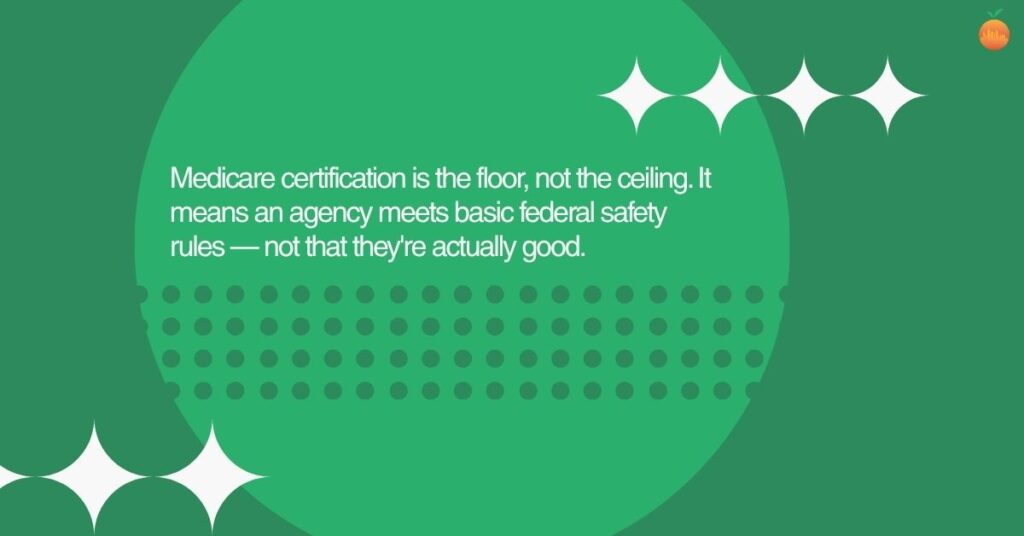
But Conditions of Participation describe a floor, not a ceiling. Meeting them qualifies an agency to bill Medicare. It doesn’t guarantee responsive communication, well-trained staff, or a genuinely coordinated care team. The ten qualities below help distinguish agencies doing the bare minimum from agencies exceeding it.
1. Agencies need to show Consistent Compliance, Not Just Initial Approval
Certification isn’t a one-time achievement. Agencies undergo periodic resurveys to confirm they still meet federal standards. Some agencies pass their initial survey and then let standards slip. Others treat every day like it’s survey day.
Ask how recently an agency was last surveyed, and whether any deficiencies were found. A clean, consistent survey history over time says more than a single certification date ever could. At City Choice, we ensure compliance by constantly conducting self-audits on all of our processes, documentation, standard of care, etc.
2. Strong Quality Ratings, Not Just Certification Status
Medicare’s Care Compare tool exists precisely because certification alone doesn’t distinguish good Medicare-certified home health agencies from mediocre ones. Every certified agency gets a star rating based on patient outcomes and satisfaction. These ratings vary significantly, even among agencies that are all equally certified.
Ask an agency about their current star rating directly. Agencies proud of their outcomes tend to share this information readily, since it reflects real, third-party verified performance rather than a marketing claim.
3. Registered Nurse Oversight, as Required and as Practiced
Federal rules require home health aides to be assigned by a Registered Nurse, with written care instructions the RN prepares specifically for that patient. This is baseline federal regulation, not an optional nicety.
The gap shows up in how faithfully agencies apply it. Some agencies treat RN involvement as a paperwork formality completed once. City Choice builds every care plan under ongoing RN supervision, with adjustments made as a client’s needs change, not just a written instruction filed away after the first visit.
4. A Clear, Documented Acceptance-to-Service Process
CMS recently added a new requirement: agencies must maintain a consistent, documented policy for how they decide whether to accept a new patient referral. This closes a gap where some agencies left families waiting without a clear answer.
Ask how quickly an agency can tell you whether they can take a case, and what that decision depends on. A well-run agency should have a clear, fast answer rather than an open-ended “we’ll get back to you.” At City Choice, we strive to have same day answers to ensure the continuity of care for all of our patients.
5. Individualized Plans of Care, Not Templates
Certification requires a documented plan of care for every patient. It doesn’t require that plan to be genuinely individualized. Some agencies rely on templates with minor edits. Others build plans around the specific home, family schedule, and medical situation in front of them.
Ask to see how a sample care plan gets structured, without expecting to see another patient’s private information. The specificity of the answer tells you a lot about how seriously an agency takes this requirement.
6. Investment in Staff Training Beyond the Minimum
Federal rules set minimum training and competency standards for home health aides. They don’t require ongoing education after that baseline is met. Some agencies stop there. Others keep training staff continuously, on topics like infection control, dementia care, and safe mobility support.
Ask whether training continues after hiring, and how often. City Choice trains staff well beyond the state and federal minimum, treating initial certification as a starting point rather than a finish line.
7. Real Patient Rights Practices, Not Just a Signed Form
Patient rights are a formal requirement under Medicare certification, covering things like informed consent and the right to participate in care decisions. Many agencies satisfy this with a signature on an intake form and little follow-through afterward.
The difference shows up in daily practice. Does the agency actually explain changes to a care plan before making them? Getting asked before, rather than just informed after, reflects whether patient rights are a lived practice or a compliance checkbox.
8. State Licensing on Top of Federal Certification
Medicare certification operates at the federal level. Most states add their own licensing requirements on top of it. In Florida, that means AHCA licensing, which brings additional oversight specific to how agencies operate within the state.
An agency holding both isn’t unusual, but it’s still worth confirming. City Choice holds both AHCA licensing and Medicare certification, adding a layer of state-specific accountability beyond the federal minimum alone.
9. Transparent Communication About Coverage
Medicare covers specific home health services under specific conditions, and coverage details can be genuinely confusing for families navigating this for the first time. Good agencies walk families through what’s covered clearly, rather than leaving them to piece it together from a benefits statement.
Ask how an agency handles authorization and eligibility questions. A responsive, clear answer here often predicts how communication will go once care actually begins.
10. Willingness to Discuss Deficiencies Openly
Every agency, even well-run ones, occasionally receives survey findings that require correction. What separates strong agencies isn’t a spotless record; it’s a willingness to discuss it honestly rather than deflect the question entirely.
Ask directly, and pay attention to how the question gets handled. A defensive non-answer says more than an honest, specific response ever could.
Certification Is the Floor, Not the Whole Picture
All ten of these qualities point to the same underlying idea: Medicare certification confirms a home health agency meets a legal minimum, not that it’s the right fit for your family. The agencies worth choosing treat that minimum as a starting point, not a finish line.
Two Medicare-certified home health agencies can look identical on paper while delivering very different day-to-day experiences. The certification itself won’t reveal that gap. Asking the right questions, and paying attention to how directly they get answered, usually will.
If you’re evaluating agencies more broadly, our guide on qualities to look for in a home health agency covers additional factors beyond certification specifically.
Frequently Asked Questions
Does Medicare certification guarantee good care?
No. It confirms an agency meets federal minimum health and safety standards, which matters, but it doesn’t measure day-to-day quality, communication, or staff consistency beyond that baseline.
How can I check an agency’s Medicare survey history?
Medicare’s Care Compare tool includes quality ratings for certified agencies. State health department websites sometimes publish additional survey and deficiency information as well.
Is a higher star rating always better?
Generally, yes, though ratings should be one factor among several. A high rating combined with vague answers to direct questions is still worth further scrutiny before committing.
Do all Medicare-certified agencies also need state licensing?
Requirements vary by state. In Florida, agencies need both Medicare certification and AHCA licensing to operate, which adds a layer of state-specific oversight beyond federal certification alone.
Talk to City Choice
Certification is where the conversation should start, not where it ends. City Choice welcomes direct questions about our survey history, star ratings, and how we exceed the federal minimum every day.
Call 305-363-7755 or request a free consultation to talk through what your family needs.