 Home Care Guides
Aging changes what a person needs day to day. Some seniors need almost no help. Others need support around the clock. Between these two extremes sit several recognized levels of care for seniors, each built around a different degree of assistance.
Understanding these levels helps families make better decisions. It also helps you avoid moving a loved one into a facility before they truly need one. For many families researching home care in Boca Raton, the goal isn’t finding the “right” facility. It’s figuring out how much support their parent actually needs right now.
This guide breaks down each level, explains who it fits, and shows where home care can meet a senior’s needs without requiring a move at all.
What Are the Levels of Care for Seniors?
Care for older adults isn’t only about where someone lives. Research on long-term care services shows that care spans several categories: medical and nursing support, personal care, social support, rehabilitation, and psychological care (Gavarskhar et al., 2022). The levels below reflect how much of each category a senior typically needs at each stage.
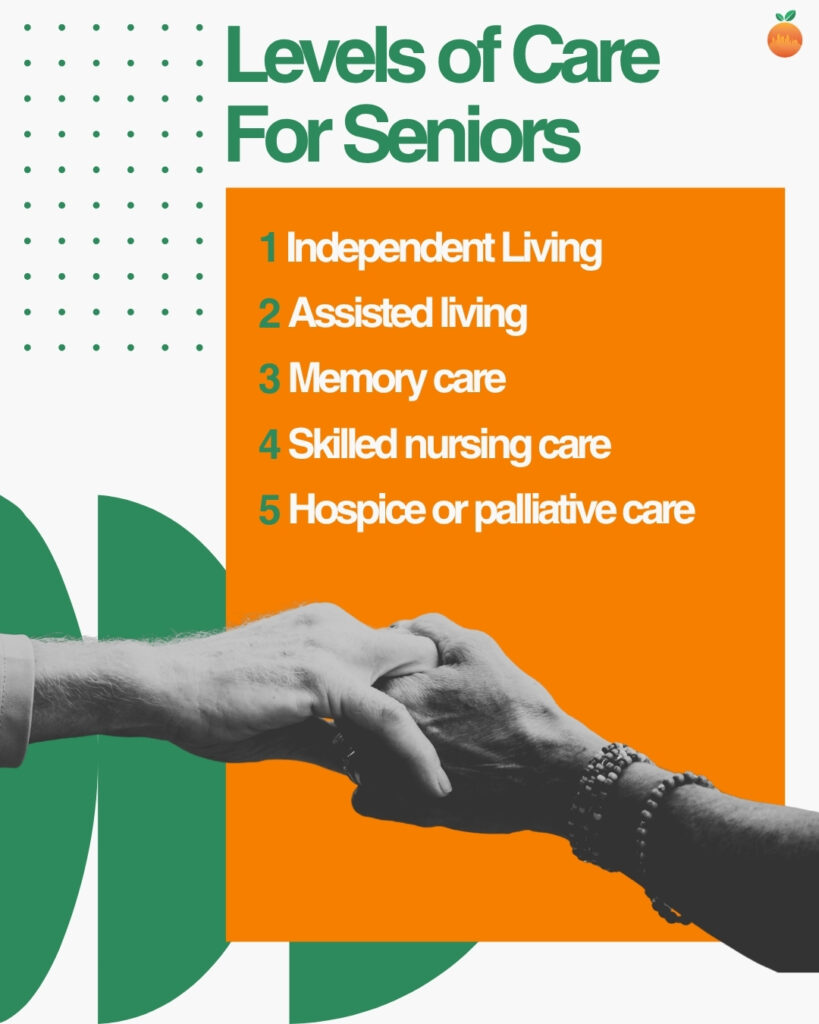
Most senior care frameworks recognize five to six levels of care for seniors:
- Independent living
- Home care
- Assisted living
- Memory care
- Skilled nursing care
- Hospice or palliative care
Not every senior moves through all six. Many stay at one level for years. Others skip levels entirely, especially when home care extends their independence far longer than a facility-based path would.
Related study: Care Services For Older Persons
What Does Independent Living Offer?
Independent living suits seniors who manage daily life without help. They cook, dress, and move around on their own. Many choose independent living communities for convenience or social connection, not medical need.
These communities don’t provide clinical care, and staff rarely monitor health conditions closely. If a senior develops a medical issue or starts struggling with daily tasks, independent living usually isn’t equipped to respond.
This is often where home care first enters the picture. A family might add a few hours of home care in Delray Beach each week, just enough to cover medication reminders or light housekeeping, while the senior keeps their independence otherwise.
How Does Home Care Fit Into the Continuum?
Home care sits in a unique spot among the levels of care for seniors. It scales up or down based on need, rather than locking a family into one fixed tier.
A senior might start with a caregiver visiting twice a week. As needs grow, that same senior can receive daily visits, skilled nursing care, therapy, or even hospice services, all without leaving home. This flexibility makes home care in Boynton Beach a practical option for families who want to delay or avoid a facility move altogether.
Home health specifically differs from general home care. Home health includes licensed nursing, physical therapy, occupational therapy, and medical social work, typically ordered by a physician. General home care focuses on non-medical support like bathing, meal prep, and companionship. Many families use both together as needs shift.
Related: Home Care vs. Home Health Care
What Does Assisted Living Provide?
Assisted living fits seniors who need regular help with daily tasks. This might include bathing, dressing, or managing medications. Staff stay on-site 24 hours a day, though care isn’t usually as intensive as a nursing home.
Most assisted living communities group residents into tiers, often labeled Level 1 through Level 3. Level 1 covers minimal support, like occasional reminders. Level 3 covers residents who need help with nearly every daily activity. Costs typically rise with each tier.
Some seniors move to assisted living because family caregivers can no longer keep up. Others move because they need supervision a home schedule can’t fully cover. Still, plenty of seniors delay this move for years by combining home care in Palm Beach with regular family support.
Related: Assisted Living or Home Care? An Honest Guide
What Is Memory Care Designed For?
Memory care serves seniors living with Alzheimer’s disease or another form of dementia. These communities feature secured entrances, structured routines, and staff trained specifically in dementia care.
Residents here often need more supervision than a typical assisted living setting provides. Wandering, confusion, and safety risks increase as dementia progresses, which is why memory care environments look different from standard senior housing.
Home care in Delray Beach can support early-stage dementia through routine visits and safety checks, though needs may eventually outgrow this option. As symptoms progress, most families eventually need a setting built around cognitive decline specifically.
What Happens at the Skilled Nursing Level?
Skilled nursing care serves seniors with complex medical needs. This includes wound care, IV therapy, post-surgical recovery, or conditions requiring constant monitoring. Licensed nurses staff these facilities around the clock.
Medicare covers skilled nursing under specific conditions, usually following a hospital stay of at least three days. Coverage typically applies to the first 100 days of care. It’s meant for recovery, not indefinite long-term stays.
Home health overlaps significantly here. Many of the same skilled services, like wound care, IV therapy, and physical therapy, transfer directly to a patient’s home. Home care in Boca Raton often serves as a more comfortable alternative to an extended nursing home stay after surgery.
How Do I Know Which Level My Parent Needs?
Start by watching how your parent handles daily tasks. Can they bathe, dress, and prepare meals without help? Do they take medications correctly and on schedule? These questions point toward the right level of care for seniors in your family.
A few signs suggest it’s time to consider added support:
- Missed medications or medication mix-ups
- Unexplained weight loss or poor nutrition
- Frequent falls or new mobility issues
- Increasing confusion or memory lapses
- A home that’s become noticeably harder to maintain
None of these signs automatically mean a facility move. Many families address these exact issues through home care first, adding support gradually as needs increase.
Can Home Care Replace a Move to a Senior Living Facility?
Sometimes, yes. Sometimes, no. It depends on the complexity of the care a senior needs and how much support their family can coordinate at home.
Home care handles a wide range of needs well. It covers personal care, medication management, light housekeeping, and companionship. Home health extends further into skilled nursing, physical therapy, and post-hospital recovery, all delivered at home.
What home care can’t replace is round-the-clock supervision for advanced dementia or complex medical conditions. Those situations usually require constant monitoring a facility can provide more reliably.
For many seniors, though, home care meaningfully extends independence. Families across Boca Raton, Delray Beach, Boynton Beach, and the surrounding Palm Beach area rely on home care to delay or avoid a facility move, sometimes permanently.
What Does Medicare Cover at Each Level?
Medicare coverage varies significantly across these levels of care for seniors. Independent living and assisted living generally aren’t covered, since Medicare treats these as housing rather than medical care.
Home health, by contrast, often qualifies for full Medicare coverage. This applies when a physician orders skilled care and a Medicare-certified agency provides it. Services like skilled nursing, physical therapy, and medical social work commonly fall under this coverage. Home care in Boynton Beach that qualifies as Medicare-certified home health often falls under this full coverage.
Skilled nursing facility stays receive partial Medicare coverage, typically limited to 100 days following a qualifying hospital stay. Memory care and long-term nursing home stays usually require private funds, long-term care insurance, or Medicaid once a person’s assets are spent down.
Related: Skilled Nursing at Home: What Medicare Will and Won’t Cover
Finding the Right Level of Care for Your Family
No two seniors follow the same path through these levels of care for seniors. Some stay independent well into their 90s. Others need substantial support much earlier, due to a health event or a progressive condition.
The best approach starts with an honest look at daily needs, not a rush toward the most protective option available. Home care often provides the flexibility to meet a senior exactly where they are, whether that means a few hours of weekly support or full skilled nursing care at home.
City Choice Home Health Care of Florida provides Medicare-certified home health services throughout Boca Raton, Delray Beach, and Boynton Beach. Our team works with families to determine exactly what level of support fits, then adjusts as those needs change. If you’re trying to figure out where your parent stands on this spectrum, reach out for a conversation about home care in Palm Beach and how it might fit your family’s situation.