 Family Caregiver Resources
What It Means for Your Family in Boca Raton, Delray Beach, and Boynton Beach
AI in home health care means monitoring sensors, fall-detection devices, and software that helps clinicians catch problems early. It isn’t robots providing hands-on care. If you’re researching home health options for a parent, here’s the short version. AI works quietly in the background. It supports licensed caregivers and nurses, but it doesn’t replace them. Here’s what that looks like for families in Boca Raton, Delray Beach, and Boynton Beach. It’s also how City Choice Home Health Care of Florida uses it.
What Does “AI in Home Health Care” Actually Mean?
“AI in home health care” covers several different tools, and most agencies only use a few of them. Understanding the categories makes it easier to know what you’re actually looking at when a provider mentions AI:
- Monitoring and sensors — devices that track vitals, motion, or falls in real time
- Predictive analytics — software that scans patient data for early warning signs of decline
- Documentation and compliance tools — AI that helps clinicians turn visit notes into structured records faster
- Scheduling and caregiver-matching software — algorithms that pair caregivers with patients based on skills, location, and availability
- Conversational assistants — apps or chatbots that answer routine questions or send reminders to patients and families
None of these tools touch a patient. They support the people who do.
Related: Home Care vs. Home Health Care: Know the Difference
Can AI Really Detect a Fall or Health Decline Before It Happens?
Mostly, AI detects a fall the moment it happens, not before. Motion sensors and wearable devices pick up the sudden movement of a fall. They send an immediate alert to a caregiver or family member. Some newer systems go further. They track gait, balance, and activity level over time. This can flag a rising fall risk days or weeks in advance. Families often manage a parent’s safety from a distance, in Delray Beach or elsewhere. For them, that early trend data often matters more than the alert itself. It gives a care team time to adjust a plan before an incident occurs.
How Does AI Help With Medication Management at Home?
Missed or wrong medication doses often send older adults back to the hospital. AI-connected pill dispensers and reminder apps address this directly. They prompt a patient at the right time. They log whether the patient actually took the dose. They alert a caregiver or family member if the patient missed it. Patients managing several prescriptions can’t easily track doses through memory alone. AI keeps that tracking consistent. It also gives families visibility they wouldn’t otherwise have between visits.
Does AI Read My Loved One’s Medical Records or Predict Hospital Readmission?
In a limited, specific way, yes. Predictive analytics tools scan patient data such as vitals, past hospitalizations, and recent clinical notes. They look for patterns that suggest a patient’s condition may be declining. When the software flags a pattern, it doesn’t diagnose anything or make a treatment decision. Instead, it surfaces a risk signal to a nurse or clinician. That clinician then decides whether the patient needs an extra visit or a call to their physician. Used well, this shortens the time between a subtle change and a clinical response. That gap is exactly what leads to avoidable ER visits.
Do Home Health Agencies Use AI to Schedule and Match Caregivers?
Often, yes, and it’s worth knowing about, even though it happens behind the scenes. Many home health agencies use software to match caregivers with patients. The software considers skills, location, and availability, and it fills shift gaps automatically. Research from Cornell’s Center for Applied Research on Work raises a fair point here. Agencies often don’t tell caregivers and families when this kind of algorithmic matching happens. That lack of transparency makes it harder to know whether the process is fair. It’s reasonable to ask an agency directly how it assigns caregivers to patients. You can also ask whether your family can request continuity with the same aide over time.
Related Article: How AI Can be Implemented More Fairly in Home Health Care and Low-Wage Work Settings
Will AI Replace My Home Health Aide or Nurse?
No. AI is good at pattern recognition, reminders, and flagging risk. It can’t bathe a patient safely or provide companionship. It can’t adjust care in the moment based on how someone feels that day. It can’t make a judgment call in a medical emergency.
A 2025 study in BMC Nursing interviewed home health nurses on this question. The nurses said they rely on touch, sight, and even smell to judge a wound’s condition. They use that same sensory judgment to read a patient’s overall state. Image-based AI tools simply can’t replicate that.
The nurses also raised something less obvious. Seeing the same patient consistently builds trust, and that trust makes treatment work in the first place. That relational piece of care has nothing to do with data.
Every legitimate use of AI in home health care today supports a caregiver. It doesn’t stand in for one. That’s especially true for Medicare-certified home health services. Licensed clinicians structure these services around hands-on care in a patient’s home.
Related Study: Navigating artificial intelligence in home healthcare: challenges and opportunities in nursing wound care
What Are the Real Risks and Downsides of AI in Home Health Care?
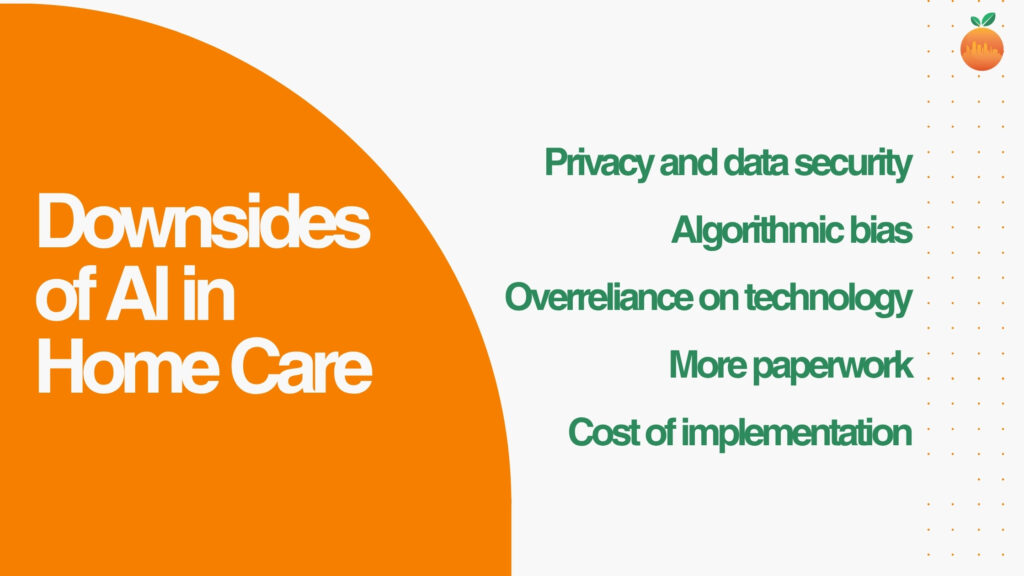
AI brings real benefits, but it’s fair to weigh the tradeoffs before assuming more technology automatically means better care:
- Privacy and data security — monitoring devices collect health data, and that data needs real protection. It’s reasonable to ask an agency how it stores the data and who can access it
- Algorithmic bias — developers sometimes train AI on limited datasets. That AI can misread patterns in certain patient populations. This is why human review of AI-flagged risks matters
- Overreliance on technology — AI should sharpen a clinician’s judgment, not substitute for it
- Patient comfort — some patients feel uneasy about in-home monitoring. That discomfort deserves serious attention, not dismissal. The BMC Nursing study found this plays out unevenly. Automated medication dispensers worked well for some patients. Others rejected the devices outright
- More paperwork, not less — AI usually promises less admin work for clinicians. But nurses in that same study reported the opposite. Existing digital systems actually increased their documentation burden. Some nurses spent roughly half to three-quarters of their working time on systems rather than patients
- Cost of implementation — not every agency invests in the same tools. So “AI-enabled” can mean very different things from one provider to the next
A provider that’s upfront about these tradeoffs is usually more trustworthy than one that only talks about the upside.
Does Medicare Cover AI-Assisted Home Health Care?
Medicare covers the service, not the technology behind it. Medicare continues to cover skilled nursing, physical therapy, and other certified home health services. This applies when a physician certifies the need and the care meets Medicare’s criteria. It doesn’t matter whether the agency also uses monitoring software or other AI-supported tools alongside that care. If an agency bills a specific device or app as a separate add-on, confirm that directly with them. Coverage there can vary by provider and plan.
How Is City Choice Using AI Alongside Hands-On Care?
City Choice Home Health Care of Florida treats AI as a support layer for our caregivers and nurses. It’s never a substitute for them. That means using tools that keep families in Boca Raton, Delray Beach, and Boynton Beach informed between visits. A licensed professional still delivers every hands-on service in person, from skilled nursing to therapy to personal caregiving. Technology helps our team catch changes earlier. It doesn’t change who shows up at the door.
What Should You Ask a Home Health Agency About Their Use of AI?
A short list of questions cuts through most of the marketing noise when you’re comparing providers:
- Is the technology supporting a licensed caregiver, or replacing one?
- Who reviews the data the AI collects, and how quickly do they act on it?
- Does the agency’s core care plan still involve regular in-person visits?
- How does the agency match caregivers to patients, and can we request continuity with the same aide?
- Is the agency Medicare-certified, and does that certification cover the actual care it provides?
Frequently Asked Questions
Does AI replace home health caregivers?
No. AI supports scheduling, monitoring, and documentation. Licensed caregivers and nurses still provide hands-on care.
Does Insurance Cover AI-Based Home Monitoring?
Coverage depends on the underlying service, not the technology. Medicare covers certified home health services based on physician certification and medical necessity. This applies regardless of any monitoring tools the agency uses alongside them.
Is my family’s health data safe with AI-enabled home health tools?
Reputable agencies follow HIPAA requirements for any data monitoring or documentation tools collect. It’s reasonable to ask a provider directly how they store and protect patient data.
Can I opt out of AI monitoring in home health care?
In most cases, yes. Agencies generally offer monitoring tools as extra support, not a mandatory part of your care plan. Ask your provider what’s optional.
What Devices Do Home Health Agencies Commonly Use?
Families most often encounter fall-detection sensors, wearable vital-sign monitors, and smart medication dispensers.
The Bottom Line
AI in home health care is a growing part of how agencies monitor safety and catch problems early. It also supports the caregivers already in your home. It works alongside people, not instead of them. City Choice Home Health Care of Florida combines Medicare-certified, hands-on care with monitoring tools. Together, they give families real peace of mind between visits. If you’re weighing home health options for a parent or loved one in Boca Raton, Delray Beach, or Boynton Beach, we can help. Our team can walk you through what care actually looks like.